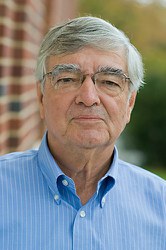
After 39 years as faculty at Penn State, Dr. Edgar Yoder is retiring as a Professor of Agricultural and Extension Education. Previously, Dr. Yoder had served 10 years as a high school agriculture teacher and principal in Ohio and Virginia. Without a doubt, he is leaving behind a legacy of success in the classroom and research outside of class at Penn State University. His 39 years at Penn State, "Went by really fast with lots of changes," he said.
When Dr. Yoder was completing his agriculture student teaching internship, he was asked by his supervising teacher to write a two page letter to the school district superintendent stating why he wanted to be an agriculture teacher and why agricultural education was important in a high school curriculum. After the end of the first week his supervising teacher and the superintendent met and discussed philosophy of education and the role of agricultural education in public education. Dr. Yoder's philosophy on agricultural education:
1.
Agricultural educators, in fact educators in
general, have two primary goals.
a.
First, as educators we assist learners in
preparing for life to earn a living, contributing to society by assuming civic
and social responsibilities and contributing to the improvement of the communities
in which they live.
b.
Second as educators we facilitate the
development of learners’ abilities for thinking critically and addressing a
broad range of social, economic, cultural and professional related issues
impacted by the agricultural sector.
2.
To address those two goals as an agricultural
educator I have a responsibility to provide learners with realistic and
authentic learning situations. This
provides learners with opportunities to develop their skills, abilities and
apply their knowledge within the social context environment of the community in
which they live and work. This means
learning is much more than taking a test or passing an exam. Learning is for real life!
3.
Teaching and learning is a democratic process in
which the teacher and learner are active participants. The agricultural educator facilitates an
active learning process. The learner is
not a passive receptacle but is an engaged participant in the process. As a teacher I learn from the students. It is impossible for the agricultural
educator to have all the answers. As an
agricultural educator you desire to have students develop the capacity to
become lifelong learners and knowledgeable about resources to access to help
address issues important to them.
4.
As an
agricultural educator I have a unique opportunity to be a change agent in the
lives of learners. Dr. Lenkiatis
reminded me in our conversation that each student was important, and that as
the ag student teacher I was expected to be flexible, within reason, for
providing a variety of learning activities so that students with a variety of
abilities could find success in their learning.
5.
Agricultural education is a unique, community
based program for youth development. Mr.
Weir knew that I had been very competitive in sports, FFA and 4-H. His words were “It is the youngster inside
the FFA jacket that should be the focus.
You will be remembered in the long run for how you helped that youngster
using the resources available through ag education (vocational agriculture back
then). You will not be remembered in the
long run for how many judging contests were won, how many times the FFA chapter
was a top ten state chapter, how many state FFA recipients, etc.”
6.
Appreciate your successes and learn from your
mistakes and criticisms.
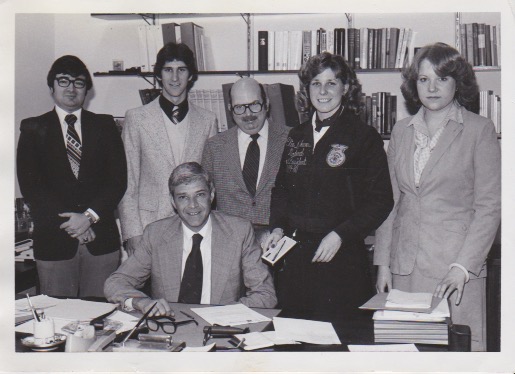
 |
Left-Right; Ed Yoder, Russell Redding, Jim Diamond,
Ellen Duckworth, MeeCee Baker
Infront; Richard Grubb |
Dr. Yoder has integrated his philosophy into the classroom by focusing on the person instead of the FFA jacket. He has borrowed strategies from other teachers that have modeled effective teaching as well. A piece of wisdom he shared was:
"You have to be yourself in an ever
changing environment. That means some
of your values and beliefs are going to be challenged as educational reforms and
changes are constantly proposed. In my personal view, I believe with all the
educational reform efforts and proposed changes, the core components of school
based Agricultural Education programs provide the foundation for making all
education relevant and truly reform education."
He suggests a few ideas of how to deal with change based on the book Who Moved My Cheese,
- Change
Happens--They Keep Moving
the Cheese
- Anticipate
Change--Be Ready For the
Cheese To Move
- Monitor
Change--Smell the Cheese
Often So You Know When It Is Getting Old
- Adapt
To Change Quickly--The Quicker You Let Go Of Old Cheese, the Sooner You Can Enjoy New
Cheese
- Change--Move with the Cheese
- Enjoy
Change!--Savor the
Adventure and Enjoy The Taste Of New Cheese!
- Be Ready To Change Quickly And Enjoy
It Again--They Keep Moving
the Cheese.
Dr. Yoder's career choice was inspired by his high school agriculture teacher Mr. Ken Smith. Mr. Smith convinced Dr. Yoder to not limit his career options because of his Amish heritage and limited resources. Mr. Smith was a guide, role model, coach, mentor, counselor, and friend to Dr. Yoder. Mr. Smith was being an agriculture teacher, and doing what they do best. He credits agricultural education, through significant role models for motivating him to become a teacher of teachers. His passion for agriculture started when he was young as his family was always involved within the agriculture sector. He realized through an experience organizing a field trip to a dairy farm for a urban school group that far too many people really do not understand the importance of agriculture in their lives. After the field trip the students refused to drink the milk in the cafeteria because it came from dirty cows.
 In his opinion the most important aspect about agricultural education is its uniqueness, and it should be a model for all education. When he was a principal he often would refer back to the basic aspects of agriculture education to resolve issues. Dr. Yoder would visit student's homes, on farms, and businesses as an agriculture teacher and as principal because it helped him understand what the student was experiencing outside of school. Agriculture education made an impact on his life as a teacher of the program using the resources available. The students had impacted his understanding and appreciation for the influence of cultural and economic factors in daily life decisions. He has learned that students reinforce how interdependent we are and how much further we have to go. Learning is a life long endeavor. His favorite part of being an agricultural educator is the people and the relationships and opportunities to work with others that have a commitment to education and agriculture collectively working to enhance the lives of others. Learning to do, Doing to learn, Earning to live, Living to serve.
Over the past 39 years Dr. Yoder has made a lot of great memories with the people (students, faculty, staff, parents, etc.) and activities/events. He doesn't view leaving as taking anything away besides maybe two paper clips, but rather he sees it as making a positive contribution to making Penn State a better education institution. He hopes that he contributed to students having positive experience as they completed their education at Penn State. We are KNOW you have Dr. Yoder. Thank you for your 39 years of wisdom and inspiration!
To learn more about starting on the path to having a career that makes a positive impact on the lives of students across the globe by becoming an agricultural educator, please contact the agricultural teacher education program at teachag@psu.edu. Follow us on Twitter at TeachAgPSU, on Facebook, or on our blog.

Luke Kerstetter
Student Blogger
Twitter Handle: @lmkerstetter96
2020 Agricultural Education Student Teacher
 Jonathan is originally from Kutztown, PA, past volunteer firefighter, and a former graduate of Agriculture and Extension Education at Penn State. Jon was led to this position because of his natural passion for agriculture education and felt his skill set suited this position well. His past experiences from his childhood, working on dairy farms, training to be a firefighter, and FFA leadership and opportunities are what define his character in present times. Jon's goals in this position is to introduce nanotechnology, 3-D printing, and the use of certification programs in Pennsylvania agricultural education programs, to be a resource for pre-service and in-service educators, and to implement the use project and inquiry based learning through agricultural educators. Outside of work Jon enjoys spending time with his family and dog Axle, as well as watching Penn State Football.
 Beth is originally from Montoursville, PA and a former graduate of Agriculture and Extension Education at Penn State. Beth was led to this position as she was looking to come back to Pennsylvania from the Baltimore area where she taught agricultural education. She felt that this position was the right fit for her, and wanted a change of life. Her past experiences from her supportive parents encouraging her along and teaching in various schools including urban education has defined who she is a person in present times. Her goals in this position are to do the best she can to support programs and teachers (new and beginning) to increase the teacher retention rate. Outside of Penn State Beth enjoys reading, yoga, and chasing her three year old.