The incredible student success stories of the Penn State Agricultural & Extension Education Program! Creating Positive Agents of Change to make the world a better place!
We welcome guest bloggers and contributors. Email teachag@psu.edu for more information!
"You may get 3 million no's, but it only takes one yes!"- Clyde McBride. On Monday, Penn State Teach Ag welcomed the Monument Valley FFA from the Navajo Reservation in Kayenta, Arizona joined their agricultural educators Clyde and Elissa McBride for a seminar on Career and Technical Education through Agricultural Education.
This event was inspiring for all who had the opportunity to attend either in person or via our social media live feed. The wise words of Clyde McBride showed his passion to educate the next generation of lives in this world. Mr. McBride's students talked about their experiences through the agriculture program at Monument Valley High School. They expressed just how much Mr. and Mrs. McBride do for them not only in the classroom but outside as well. Overall this seminar provided inspiration for current and future agricultural educators to do all that they can to assist the students in learning responsibility, communication skills, and life lessons.
My take from this seminar was learning that agricultural education can happen anywhere, and that it should be taught in more schools. Listening to the students talk about their experiences from the program all I could think about is the difference agricultural education could make if over half of the high schools in the United States had this program. The rewards of this program are seeing students gain knowledge, grow in values, find out who they are and what they want to do in the future. The wisdom shared by Mr. and Mrs. McBride for future agricultural educators ignited even more passion for agricultural education. Their way of empowering each student gives me hope that agricultural education will always benefit the student. If you didn't get to attend this seminar check out the video feed that is on our Facebook page Teach Ag! at Penn State.
Additionally, here is the recorded video from our YouTube Channel:
To learn more about starting on the path to having a career that makes a positive impact on the lives of students across the globe by becoming an agricultural educator, please contact the agricultural teacher education program at teachag@psu.edu. Follow us on Twitter at TeachAgPSU, on Facebook, or on our blog.
Watch this awesome YouTube video created by Britney Marsh (@b_marsh216) and her students on the power of school-based agricultural education at Arizona Agribusiness and Equine Center - Red Mountain (@AAEC_FFA).
It was entered in the NAAE (@NAAE) Advocacy Video Contest and selected as an honorable mention video! It will be showcased at the 2014 NAAE Convention in Nashville, TN!
Did you know that South Africa is the second largest
exporter of fruit? Or has its own penguin colony? Or that it has the third
highest level of biodiversity in the world?!? Well one of Penn State’s AEE Alumni
from 2013, Britney Marsh, is actually taking a group of her high school agriscience students to South Africa from
May 25th to June 2nd!
Britney Marsh is a secondary Agricultural Educator/FFA adviser at Arizona Agribusiness and Equine Center (AAEC)- Red Mountain Career Prep High School in Mesa, Arizona. She has traveled a long way to teach her amazing group of students and is now taking ten of them on an exciting adventure. They will be traveling and staying in Port Elizabeth at the Ulovane Environmental Center as well as traveling to the Amakhala Game Reserve.
If you have never heard of the game reserve before, it
is a fantastic place. The founders wanted to make a malaria free safe zone in
the eastern part of the country for animals to roam freely. They are trying to
restore the land into its natural conditions again. The students will have the
opportunity to learn about terrestrial plants, different bird species, and about the
mighty mammals of South Africa. They will also be observing animal behavior on
the reserve.
A group of tourists on the reserve!
On top of all of that, they will be going on night safaris, exploring
the marine intertidal ecosystems, look at the changing vegetation at the AddoElephant Park Woody Cape, going on a coastal scrub, and even looking at the
dune forest in the diverse Albany Thicket. Studying is not the only thing they
will be doing. They will have the chance to visit the village of Patterson
where they will visit an Isipho village, (a program that helps the iNzinga people) multi-purpose facility which assists victims of AIDS. They will sit in
on a lecture of the “Role of the Wildlife Veterinarian in South Africa.” Then
they will be able to learn how to capture and immobilize animals. After they
learned the proper procedures, they will actually practice shooting darts and
then capture antelopes by themselves! They will practice ear notching and
taking blood samples for DNA. Crazy right?! There will be no breaks on this
amazing educational trip!
Britney is looking forward to bringing new information
for her classes next year. The trip should be an awesome experience for all
people that will be in attendance!
If you would like more information about the trip, or how
you can start a trip like this in your school, Britney Marsh (@b_marsh216) provided her email
address: BMarsh@aaechighschools.com,
To learn more about starting on the path to having a
career that makes a positive impact on the lives of students across the globe
by becoming an agricultural educator, please contact the agricultural teacher
education program at teachag@psu.edu. Follow us on Twitter at TeachAgPSU, on Facebook, or on our blog!
Note from the Editor: The following is an excerpt/observation of Jillian Gordon, a 2015 student teacher candidate and a participant in the 1st annual PSU Teach Ag Society Domestic Study Abroad Trip to Arizona. The Trip was for 8 days, and 13 teacher candidates traveled over 1500 miles visiting 6 outstanding programs (2 urban, 2 rural, 2 reservation) and 3 state/national parks. A huge thank you to the CHS Foundation for their continued support of the National Teach Ag Campaign and programs to prepare multiculturally competent agriscience teachers for the world! This is the first of what we hope to be several installments of observations by members who attended the trip.
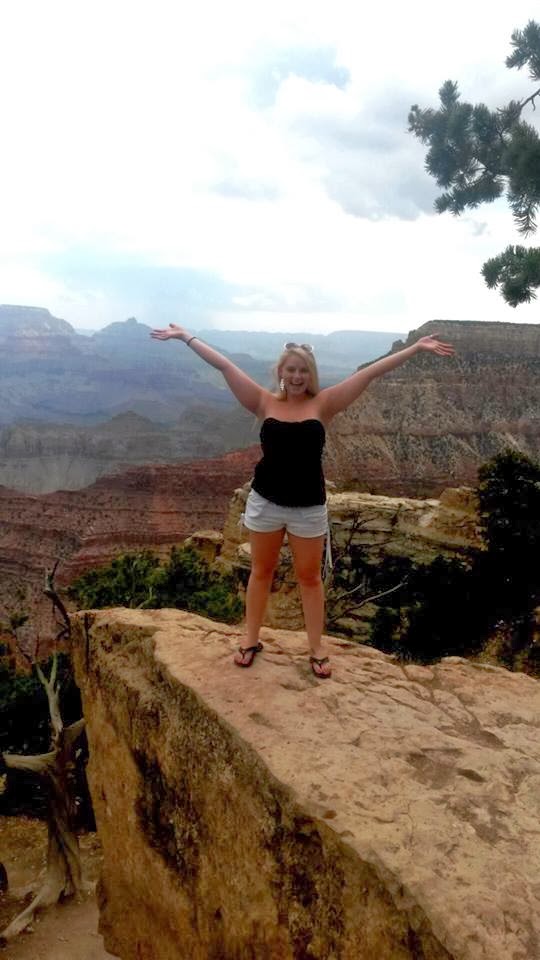
Sitting off by myself, I stared off into the Grand Canyon, wonder and curiosity sifting through my brain. The site of the sheer enormity offered by the Grand Canyon put me in a place that I had never really thought about before. Regardless of how long you stare, you will never really take it all in. Regardless of how hard you try, it would be almost impossible to see every last piece of it and appreciate it for all that it’s worth. Thinking to myself, things began to click. I am a huge fan of cheesy metaphors, and this one might have just been the best I’d had yet. Travelling across the country to see all of these amazing agricultural science programs in Arizona, I thought it was only fitting we stopped at Grand Canyon National Park to see one of the wonders of the world. And if you really think about it, the Grand Canyon and Agricultural Education have a lot in common. Now before you write me off as nutty, before you start wondering who exactly let this crazy girl on this trip, how about I get you a little context, shall we?
I like to call myself an agricultural education junkie, and in May I was able to get my fix and scurry across the country to see the Grand Canyon State with Penn State’s Teach Ag Society on their first every Domestic Study Abroad Trip made possible by a generous sponsorship from the CHS Foundation. Ever since I had first signed up for the trip, I was counting down the days until the semester ended and I was boarding a plane. When the trip finally came around however, the departure was not what I was expecting. I was sick from an ill-timed head cold, queasy from the shaky landing that the Phoenix airport offered it’s travelers, and worn out from a hectic semester. At first, the trip that I had been so excited about seemed to turn into something that I was dreading. I will be honest, for the majority of the trip my body felt miserable. My mind, however, was healthier than it had been in a long time.
After travelling over 1500 miles across the Grand Canyon State, I am sure that you could guess that I took in plenty of remarkable sites. I was able to see the desert landscape, something that until then I had only pictured in my head as a Road Runner cartoon. It was refreshing to see that Arizona was nothing like I had imagined, after driving through beautiful state forests and finally the mesas and red rocks of the north. Travelling north onto the Navajo Reservation, I was able to see the beautiful Canyon De Chelly and as previously mentioned, Grand Canyon National Park.
The sites were beautiful. The truly touching experience, however, was the reason we came in the first place, to see what ag education was like on the other side of the country.
Looking back, I couldn't think of a more fulfilling and diverse experience in learning about school-based secondary agricultural education than the one we had in Arizona. From urban to rural, to schools on the Navajo reservation, the variety of programs we saw was mind-boggling. The more rural schools of Payson and Chino offered facilities unlike most of what we can see in Pennsylvania. A full working farm at Chino gave students the opportunity to truly have hands on experiences to supplement what they were learning in the classroom. While visiting Payson we were able to see a facility that was completely separate from the rest of the school, a show barn that allowed students to house their project animals and learn how to care for these animals. Heading further north to Monument Valley and Many Farms, I received a lesson not only on agricultural education in the area, but also the difference in culture. We were able to engage in Native American education delivered by a state public school, Monument Valley (A school noted by Time Magazine Schools that Work) and a Bureau of Indian Affairs (BIA) boarding school in Many Farms. Students who I at first perceived to be so different from myself were more similar than I could have imagined. With seemingly all 49 states in between our homes, who could have guessed that I would have clicked with these students just as I do with students here in Pennsylvania?
The more urban schools of Peoria and Gilbert offered the same shock and awe of the previous schools. Although each program was so amazing different, each program fit exactly what their community needed, making them each equally successful. While every program we visited was completely different from the next, there were two common factors throughout the entire trip, passion and dedication. When talking to students about their involvement in their programs, you could see their eyes glisten and their smiles just light up when thinking about the experiences they've had. All of the teachers we interacted with had the passion and dedication to their students. I watched an ag educator choke on her words when talking about having to leave her program to move closer to her husband. I was just about ready to cry along with her. To put it simply, students are students and Ag Teachers are Ag Teachers! No matter where you go, they are passionate, they are curious and they are smart. Students are capable of more than you could ever predict. On top of that, I was able to see that no matter where you go agricultural educators put students first.
So now you’re wondering, “how exactly is the Grand Canyon like Ag Education?” From the perspective of the student, the Agricultural Education profession can have an impact as vast as the Grand Canyon itself. The student might not ever be able to see just how large the impact their teacher has not only on them but also on their peers. But neither will the teacher. Now does this mean that ag educators are the be all and end all? That once they've impacted a few of their students that their job is done? Absolutely not. When we compare the size of the Grand Canyon to the immensity of our planet itself, it seems rather, small doesn't it? That does not mean that it’s influence and power to awe is any less meaningful. It simply means that that Ag Education always striving for more. When a great teacher is matched with their students, an outcome occurs that is as amazing of any of The Seven Wonders of the World. This trip has lit a fire under me unlike any other, and I am excited to see where the best job in the world takes me someday.
Often, I have heard agricultural education majors talk about hoping to stay close to home when applying for teaching jobs. I get that, I understand wanting to go back to the program that helped encourage us to want to teach in the first place. But, we are lucky in Pennsylvania as that currently we do not have any openings going unfilled. After seeing how unequivocally unique but also shockingly similar school-based agricultural education is in Arizona, I have to ask myself how could I ever NOT want to go anywhere that this profession calls?
This blog was written by Jillian Gordon, 2015 Student Teaching Candidate. Jill is also serving as a 2013-2014 National Teach Ag Ambassador.
To learn more about starting on the path to having a career that makes a positive impact on the lives of students across the globe by becoming an agricultural educator, please contact the agricultural teacher education program at teachag@psu.edu. Follow us on Twitter at TeachAgPSU, on Facebook, or on our blog!
Ms. Jillian Gordon
Student Blogger
2015 Student Teacher
@jillianpsu 2013-2014 National Teach Ag! Ambassador


 To learn more about starting on the path to having a career that makes a positive impact on the lives of students across the globe by becoming an agricultural educator, please contact the agricultural teacher education program at teachag@psu.edu. Follow us on Twitter at TeachAgPSU, on Facebook, or on our blog.