Showing posts with label Cumberland Valley. Show all posts

Monday, September 12, 2022

NAAE Region VI Outstanding Agricultural Education Teacher Awarded to Ms. Darla Romberger


The Center for Professional Personnel Development would like to recognize Ms. Darla Romberger, an Agricultural Education Teacher at Cumberland Valley High School in Mechanicsburg, Pennsylvania, for being selected to represent Region VI of the National Association of Agricultural Educators for the Outstanding Agricultural Education Teacher Award. 

 Ms. Romberger shares, "After my student-teaching internship at the Milton Hershey School, I was hired at Cumberland Valley High School in August of 2013 and have been at CV ever since! Over the past 10 years, I’ve taught a variety of coursework across the Animal Science, Plant Science, and Ag Mechanics pathways. If I had to choose a favorite course, it would be CASE Animal & Plant Biotechnology or Agricultural Fabrication. I’ve also served as a CASE Lead Teacher since 2016 and have co-taught in-person and virtual CASE Institutes in Animal Science and AFNR." As you can tell, Ms. Romberger has gained a plethora of teaching experiences under her belt as she is entering her tenth year in the classroom!

Ms. Romberger is not new to agriculture in fact she grew up on a farm where her family custom-raised dairy heifers and grew corn, soybeans, small grains, and hay crops. She also got a glimpse into agribusiness as her parents own and operated a feed mill and nutritional consulting service. These led to involvement with 4-H and FFA where she then found a niche exhibiting livestock at county fairs and the PA Farm Show. She said, "I loved being involved in agriculture-related activities and had always considered being a teacher, so I was excited to learn that a career as an Ag Teacher existed so I could combine my interests!"

From there Ms. Romberger was hooked and grew her passion for teaching and agriculture by continuing her education at Delaware Valley University. "During my undergraduate career at Del Val, I was a Supplemental Instruction Leader for several Chemistry courses for 3 years. In this position, I led group tutoring sessions, retaught lectures and labs, and conducted test prep sessions. What I thought was going to be a short-lived job turned into a phenomenal 3-year experience where I solidified my passion for teaching and helping students find success." Her passion and enthusiasm for teaching started to shine through her students and still does today.

She shared why she is inspired to teach agriculture. "My passion is teaching others about the source of food, fiber, and natural resources and the science behind getting agricultural products to consumers. Each day is a new opportunity to make an impact on the future of agriculture and help students find their passion through school-based Agricultural Education. I firmly believe that each student has a strength they can share with others and that every student can gain valuable life experiences through Agricultural Education and FFA."

As Ms. Romberger continues to pave her path through agricultural education she said that her favorite part of being an Agricultural Educator is the variety of experiences that come with the job. "I enjoy teaching a variety of agricultural subjects throughout the day and designing FFA & SAE opportunities to help students apply classroom knowledge to real-world experiences. I also enjoy continuously learning about new advancements in agricultural science through professional development and collaborating with colleagues across the nation." 

While some of her favorite parts about being an Agricultural Educator involve the students, there are challenges that also come along with teaching students day in and day out. "The most challenging part of teaching agriculture is balancing your strengths and agricultural interests as a teacher with student interests and the needs of the community. In some cases, this means taking extra time to learn a new content area or find community resources to support a new course. However, approaching this challenge with an open mind can be extremely rewarding and lead to great relationships with community supporters and unique SAE opportunities for students."

The Agricultural Education program at Cumberland Valley High School is a rockstar program that has gained various recognition across the state and nation. Cumberland Valley Agricultural Sciences is a 3-teacher program that supports 275 students in grades 9-12. The department is split between 2 buildings (a 9th grade academy and 10th-12th grade high school). The program offers a CASE Plant Science and a CASE Animal Science pathway with courses that fulfill science graduation requirements and 3 rotating Agricultural Mechanics courses. 

The program is adding a CASE Natural Resources pathway in the 2023-24 school year to align with a renewed community focus on environmental sustainability. Touted as one of the fastest growing school districts in Pennsylvania, the Cumberland Valley School District is primarily suburban with several preserved farms in the western part of the school district. There are numerous animal nutrition, food science, hydroponics, and nursery landscape businesses within the school district. With these demographics, AgriScience is the primary focus of the coursework so students understand the science, processing, and marketing aspects of agriculture and natural resources industries. An FFA Leadership Team of 7 FFA Officers and 6 Committee Chairs develop and lead a progressive Program of Activities that includes nearly 100 events to Grow Leaders, Strengthen Agriculture, and Build Communities.

Some CV program highlights include:

  • 2017 PAAE Outstanding Agriculture Program
  • Cumberland Valley FFA has been a nationally recognized 3-Star FFA chapter since 2013
  • 15 FFA State Champion Teams since 2013
  • 9 FFA State Runner-Up Teams since 2013
  • 30 State FFA Proficiency Award winners since 2013
  • 89 Keystone FFA Degree recipients since 2013

A few words of wisdom that Ms. Romberger shares for any high school students considering a career in agricultural education is to "take advantage of any opportunity to lead a group, present a workshop, or volunteer with an agricultural organization! Don’t be afraid to talk to current Ag Teachers in your school or county to offer help with ag literacy events, officer retreats, or other education-related events."

Congratulations again, Ms. Romberger on earning the Outstanding Agricultural Education Teacher Award. You represent Pennsylvania Agricultural Education with great pride, and we could not be more excited to have you represent our state and region at the National NAAE Convention this November in Las Vegas, Nevada.


Morgan Bear

CPPD Student Worker

Agricultural and Extension Education 

Class of 2023

Friday, February 15, 2019

Global Learning in Agriculture at Cumberland Valley

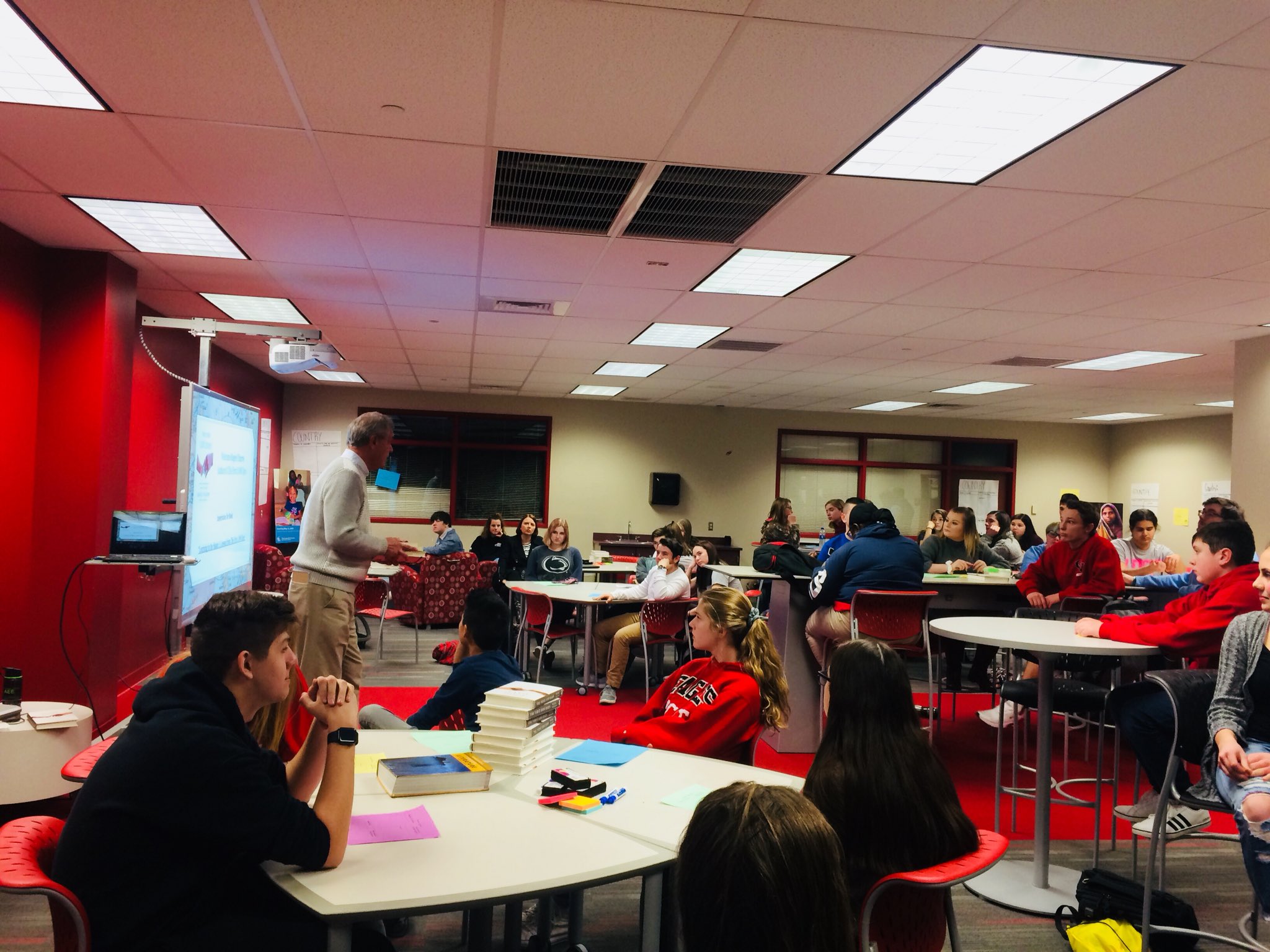
On January 30th, 2019 the Global Teach Ag team as well as Roger Thurow went to Cumberland Valley High School to do activities with students centered around his book The First 1,000 Days: A Crucial Time for Mothers and Children.


ImageThe group also got to take a look at Cumberland Valley’s Agricultural Education Program, and talk with Darla Romberger, the agri-science teacher at Cumberland Valley which was an exciting opportunity considering that this was Roger Thurow’s first time seeing an agricultural education program.

The activity was attended by students in three classes: agri-science, AP history, and culinary. For the activity, students were divided into four groups that represented the four countries that Roger discusses in his book.These countries were The United States, Uganda, India, Guatemala. Each country was given a large problem that was featured in the book, and the groups brainstormed along with Thurow, Romberger, Global Teach Ag, and Penn State Professors. It was an amazing opportunity for students to combine what they learn in the classroom with critical thinking skills. It is exciting to see students that are passionate about solving real world issues and taking steps to be involved in the process of becoming positive agents of change.


Erin Langdale
Communications Team Member
Twitter: @ItsErinLangdale
Agricultural Education Student Teacher 2020

Tuesday, July 10, 2018

The 2018 CASE Institute: What a blast!

The participants of the 2018 CASE Institute.
The 2018 CASE Institute has come to an end, and our participants from all over the country have come out more confident, prepared, and certified to deliver proper instruction on mechanics and technology to their students.

This year's CASE Institute was held at Cumberland Valley High School and hosted by #psuaged alum Ms. Darla Romberger (@DJR_131). The institute ran from June 17th to the 28th, where participants were able to be certified through CASE's Agricultural Power and Technology curriculum.

Over the course of two weeks the program covered 180 days of curriculum, and included topics useful to any agricultural teacher such as shop safety, machine and tool operation, fabrication, energy and power, and more! Attendees got to not only practice themselves, but learn how to meaningfully teach on these topics.

CASE provides 10 courses that fall under four major pathways covering almost every aspect of Agricultural Education. Each of these courses aligns with national standards for agriculture, science, mathematics, and English language arts. The Agricultural Power and Technology course is just one of the many courses that Penn State will continue to help provide for pre-service and in-service teachers.

Follow us on Twitter (@TeachAgPSU) and Facebook to stay up to date on all of the professional development opportunities that Penn State Teach Ag offers, and be one of the first to hear about the 2019 CASE Institute!


To learn more about starting on the path to having a career that makes a positive impact on the lives of students across the globe by becoming an agricultural educator, please contact the agricultural teacher education program at teachag@psu.edu. Follow us on Twitter at TeachAgPSU, on Facebook, or on our blog.


Hunter Kauffman, Student Blogger 
Wildlife and Fisheries Science
College of Agricultural Sciences
Email: hlk5120@psu.edu

Thursday, September 17, 2015

Program of the Month: Cumberland Valley High School #studentsuccess

In Pennsylvania we have over 150 FFA chapters that represent the Blue and Gold at its finest. There is one chapter that has stood above the rest this month to become our September Program of the Month. I am proud to say that my alma mater, Cumberland Valley High School, is that program.

 FFA members were invited to
volunteer with the 75th Anniversary of Heifer International.
CumberlandValley’s FFA was chartered in 1954 with goals to focus on professional development and enhancement of their leadership capabilities on their members. Under the supervision of Ms. Darla Romberger and Mrs. Weyer, Cumberland Valley since then has developed CASE curriculum and have had active students in the community with their various service projects. They are event branching out of the community to corporate agriculture companies such as Heifer International, competing in career development events on the State and National level, and are constantly making a name for themselves.
Cumberland Valley Agriscience Program offers a wide array of classes for their students to take including:
Case Introduction to Agriculture, Food, and Natural Resources
CASE Animal Science
CASE Plant Science
CASE Food Science
CASE Animal and Plant Biotechnology
Agricultural Power and Technology
Agricultural Fabrication
FFA Leadership I and II

 
Some of their latest chapter accomplishments are highlighted below:
National Chapter Award: 3-Star Chapter Ranking in 2013, 2014, and 2015

First Place State FFA Marketing Plan Team (2015)

Second Place State FFA Horse Evaluation Team (2015)

National Silver Ranking in Agricultural Communications (2014)

5th Place National Gold Ranking Parliamentary Procedures Team (2013)

4 State Proficiency Winners

6 State Proficiency Finalists (2015)

2 National Finalists in FFA Agriscience Fair (2014&2015)

Recipient of $2,500 National FFA “Food for All” Grant (2014)

Recipient of $2,500 National FFA “Living to Serve” Grant (2014)

FFA Banquet- Over 250 members, parents, school administrators, and guests present. 
Cumberland Valley has done a great job in being an awesome chapter and having a great curriculum for students to help ready them for career and educational success. We look forward to seeing more from this chapter and what great things are yet to come!

If you would like to contact them for information about the program you can reach them at these social media outlets:


Facebook: Cumberland Valley FFA
FFA Twitter: @CV_FFA1954
Program Twitter: @CV_AgSciences
Instagram: @cvffa 


To learn more about starting on the path to having a career that makes a positive impact on the lives of students across the globe by becoming an agricultural educator, please contact the agricultural teacher education program at teachag@psu.edu. Follow us on Twitter at TeachAgPSU, on Facebook, or on our blog


Olivia Murphy-Sweet
Student Blogger
Teach Ag! Avenger
Twitter Handle @OSweetMurph  
2016 Agricultural Education Student Teacher 

Thursday, August 28, 2014

PSU CASE Institute: The Host School Perspective from Cumberland Valley! #case14asp

As the summer was winding down, the Center for Professional Personnel Development and the Cumberland Valley Agriculture Department were putting the finishing touches on the plans to host a Curriculum for Agricultural Science Education (CASE) Summer Institute. The institute hosted this year was Agricultural Science--Plant to complement the previous institutes offered in 2012 (Agricultural Science-Animal) and 2013 (Introduction to AFNR), respectively. With 17 Agriscience teachers from 7 states registered and 2 fantastic lead teachers in place, #case14asp hit the ground running on August 3rd and continued until August 13th.

CASE is a one-of-a-kind curriculum that shifts the classroom towards student-based learning and inquiry-based instruction where students apply critical thinking skills and problem-solving each and every day in the classroom.  Students are challenged to take control of their learning and become an active member of the learning community.  For many agriculture programs, this curriculum is implemented to increase the rigor and relevance of agricultural science while preparing students for diverse careers in the field of technical agriculture.

A unique professional development experience in itself, CASE institutes equip teachers with the content they will teach by employing 2 Lead Teachers that guide participants through key Activities, Projects, and Problems that make up the curriculum. Certified CASE teachers have seen the curriculum through a student's eyes and have completed the lab activities and projects firsthand to lead their classes with confidence through the new content. Rather than leaving with a binder full of worksheets, answer keys and video clips, teachers are prepared to develop an engaging classroom environment and lead students in inquiry-based lessons.

New this year to the CASE arsenal is CASE Online, a resource available to certified CASE teachers. This system provides students and teachers an online method to communicate while completing coursework and share course assignments and assessments. End-of-course assessments and review question banks are now available through this platform for teachers already implementing CASE curriculum.

In addition to learning the curriculum and about available resources, CASE workshops are an excellent opportunity for new and beginning teachers to gain "tricks of the trade" from experienced lead teachers and colleagues with years of teaching under their belt. During several lab activities, participants would volunteer their expertise and provide value-added classroom extension projects that were successful in their past classes. This professional collaboration is often a driving factor in motivating teachers to return to CASE institutes each summer to increase the rigor and relevance of their classes and prepare students for employment in the 21st century food and fiber industry.

Although the end of the institute came way too quickly, the friendships, partnerships, and camaraderie developed at this institute will continue to grow as the 17 certified CASE teachers will communicate throughout the school year and work together through classroom challenges. I look forward to see how my fellow participants will implement CASE in their classrooms this upcoming year and how many students will be impacted through the CASE program into the future.

For more information on available CASE curriculum, CASE Online, and upcoming CASE pilot courses, please visit www.case4learning.org.

To learn more about starting on the path to having a career that makes a positive impact on the lives of students across the globe by becoming an agricultural educator, please contact the agricultural teacher education program at teachag@psu.edu. Follow us on Twitter at TeachAgPSU, on Facebook, or on our blog
Darla Romberger
Cumberland Valley Agriculture Science Teacher
Guest Blogger
Current PSU M.S. Student
2014 PSU Student Teacher


Thursday, May 1, 2014

5th Annual Teach Ag! Essay Event Top 4 Announced! #studentsucess


When most students hear the word “essay”, you will typically see angry and annoyed faces or students jumping out of the room to avoid the work. That is not the case for some exceptional students from throughout Pennsylvania. This year, the Teach Ag! Society hosted the 5th annual Teach Ag! Essay Event. It was our most successful year yet, with 83 entries from over 26 different schools!


Mackenzie Yorlets teaching a class!
If you have never heard of this event before, you will be surprised to learn what all of these students had to accomplish. The outline for the event is to teach an agriculture class in their high school to their classmates and then write an essay answering the questions, “Why Teach Ag?” and “What I learned as an ag teacher for a day!” 

They also had the option to submit a YouTube video to demonstrate their lessons! This is an awesome opportunity for the students to explore if they want to make a career out of teaching agriculture, there are some additional benefits for participating.  

Each contestant gets to receive a limited edition PSU Teach Ag! T-shirt, have an ice cream social in their honor after the opening session of the State FFA Convention, as well as, the top four each receive a gift card for National FFA, and the first place winner in addition to the gift card and t-shirt receives free registration for a 2014 FFA Event of their choosing! 

After learning about everything that these amazing students had to do, it is our pleasure to announce the top four participants in the Teach Ag Essay Event!

           Mikayla Barnhart, James Buchanan High School
Agriscience Teacher: Mr. Herb Hoffeditz


Kevin Dressler, Selinsgrove Area High School
Agriscience Teachers: Ms. Valerie Fry & Mr. Curt Swineford


'

Kristopher Heacox, Derry High School
Agriscience Teacher: Mr. Roy Campbell


Mackenzie Yorlets, Cumberland Valley School
Agriscience Teacher: Ms. Darla Romberger

Congratulations to the top four and all participants! The winner of the contest will be announced during the opening session on Tuesday night of that Pennsylvania FFA State Convention at Penn State!
To learn more about starting on the path to having a career that makes a positive impact on the lives of students across the globe by becoming an agricultural educator, please contact the agricultural teacher education program at teachag@psu.edu. Follow us on Twitter at TeachAgPSU, on Facebook, or on our blog!


Olivia Murphy-Sweet

Student Blogger
Teach Ag! Avenger

Twitter Handle @OSweetMurph
2016 Agricultural Education Student Teacher 


Saturday, July 6, 2013

CASE: Your Vessel to Applied STEM through Agricultural Science Education


As agricultural educators, we are continually inundated with countless projects, obligations, and new tasks. Agricultural educators are the most innovative teachers on the planet.  Why?  Because we understand the importance of a competitive and competent world.  Just like the American Farmer, we must always think critically for the advancement and betterment of society.  As we advance into 21st Century teaching methods, educators of agricultural science must remain at the forefront of education as engineers creating and designing the newest vessel to deliver applied STEM through agriculture.  This, my friends, is where CASE (The Curriculum for Agricultural Science Education) enters the mix as the tool to allow us, as positive agent of change, to enhance the relevance and rigor of our agricultural science curriculum. 


Recently, twenty-one agricultural science educators from seven states met at Cumberland Valley High School in Mechanicsburg, PA for a refreshing professional development opportunity hosted by the Penn State Center for Professional Personnel Development at Cumberland Valley High School in the realm of STEM delivery and how we teach learners of agricultural education the fundamentals and foundations of our diverse curricula.   Albeit, at the beginning of this two-week training some were apprehensive – BUT shortly after the institute began, everyone was fully invested in the learning experience afforded to them through #PSUCASE13 – Curriculum for Agricultural Science Education Introduction to Agriculture, Food, and Natural Resources Institute[AFNR]. (Click here to view the twitter feed for this experience)

How do we learn best?  BY DOING!  CASE Institutes do just that.  Agricultural educators are challenged as they progress through Activities, Projects, and Problems presented through CASE methodologies – which build upon a pedagogy that spirals and scaffolds the curricula.   

Science and mathematics are not “included” in CASE curriculum, rather science and mathematics are purposely and properly taught to provide true integration of core-academics. CASE does NOT assume students should know how to perform a science skill or mathematical operation – these are purposely taught within the context of AFNR. (Click here to learn more about the AFNR Course)

It has been stated that, “CASE is the most powerful tool available for the advancement of agricultural education and enhancement of student learning of agricultural science subject matter.” Truth be told – if you want ‘up the ante’ of your agricultural science program, - EXPLORE the opportunities of CASE!  Find more time to ‘Do what you love – Love what you do,’ by allowing the CASE Team to lay the foundation for you!  Think of the possibilities! 

Learning more by visiting: www.case4learning.org or following on Twitter @case4learning.  To learn more about starting on the path to having a career that makes a positive impact on the lives of students across the globe by becoming an agricultural educator, please contact the agricultural teacher education program at teachag@psu.edu. Follow us on Twitter at TeachAgPSU, on Facebook, or on our blog! 


Mr. Mike Woods
Guest Blogger
Cumberland Valley Agriscience Teacher/FFA Advisor
@CV_Aggie
2009 Graduate of Penn State AEE