Showing posts with label #PSUAgEd2TN. Show all posts

Monday, May 16, 2016

Domestic Study Away Day 5: Rising above the Challenges! #PSUAgEd2TN


Editors Note: The following is a reflective observation from different students participating in #psuaged2TN, our domestic study away program. Halee Wasson (@wasson_halee
), a sophomore and member of #psuaged18, shares below.  This incredible event is made possible by the generosity of the CHS Foundation.


As I reflect upon the last day Penn State Teach Ag! Society explored Tennessee’s Agricultural Education Programs, I find myself referencing the following quote: Never stop learning because life never stops teaching.” As a student I am constantly learning; which is why I find education valuable, since I can take what I learn in the classroom and connect it to an experience I am participating in at that time.

On Friday May 13th, Penn State Teach Ag! Society traveled to Clarkrange High School in Clarkrange, Tennessee to explore their Agricultural Education Program. Clarkrange High School is located in the small community of Clarkrange in Fentress County. After visiting metropolitan schools earlier this week, this visit was a great way to wind down, and participate in a rural school experience. The size of CHS’s student body is around 300 students, with an average graduating class size of 60 students. Although small, Clarkrange’s Career Technology Education (CTE) program provides many opportunities for their students to explore and expand their knowledge in career fields related to their interest. We were given a tour of all these CTE programs by Mr. Lee Little (referred to as Mr. Lee); who was the past Agricultural teacher, but is currently serving as the director of the CTE program. Although we enjoyed learning about all their programs, our biggest interest was at our last stop of the tour—the Agricultural Education Program.

During our time in Clarkrange’s agriculture classroom we were able to engage with students and teach them about the many opportunities and careers in the agricultural industry. With the class sizes being no larger than 14 students, we taught our lesson in pairs of two. This provided the other Penn State teacher candidates who were not teaching time to engage in discussion with Mr. Pat Little (referred to as Mr. Pat); who is the current agricultural teacher. Mr. Pat is an amazing individual who is never short of words for the subject he is passionate about – teaching agriculture! Passion and dedication is truly the driving force behind the success of this program.  Every question we presented to Mr. Pat or Mr. Lee was answered with stories of their personal experiences pertaining to the subject matter. These men truly devote themselves to bettering their students, school, and community. They have many successes that they can claim; however, Mr. Lee pointed out, “Although successes are important, failures are just as important.” Like all programs, Mr. Pat admitted to challenges that are presented in his rural school and community.
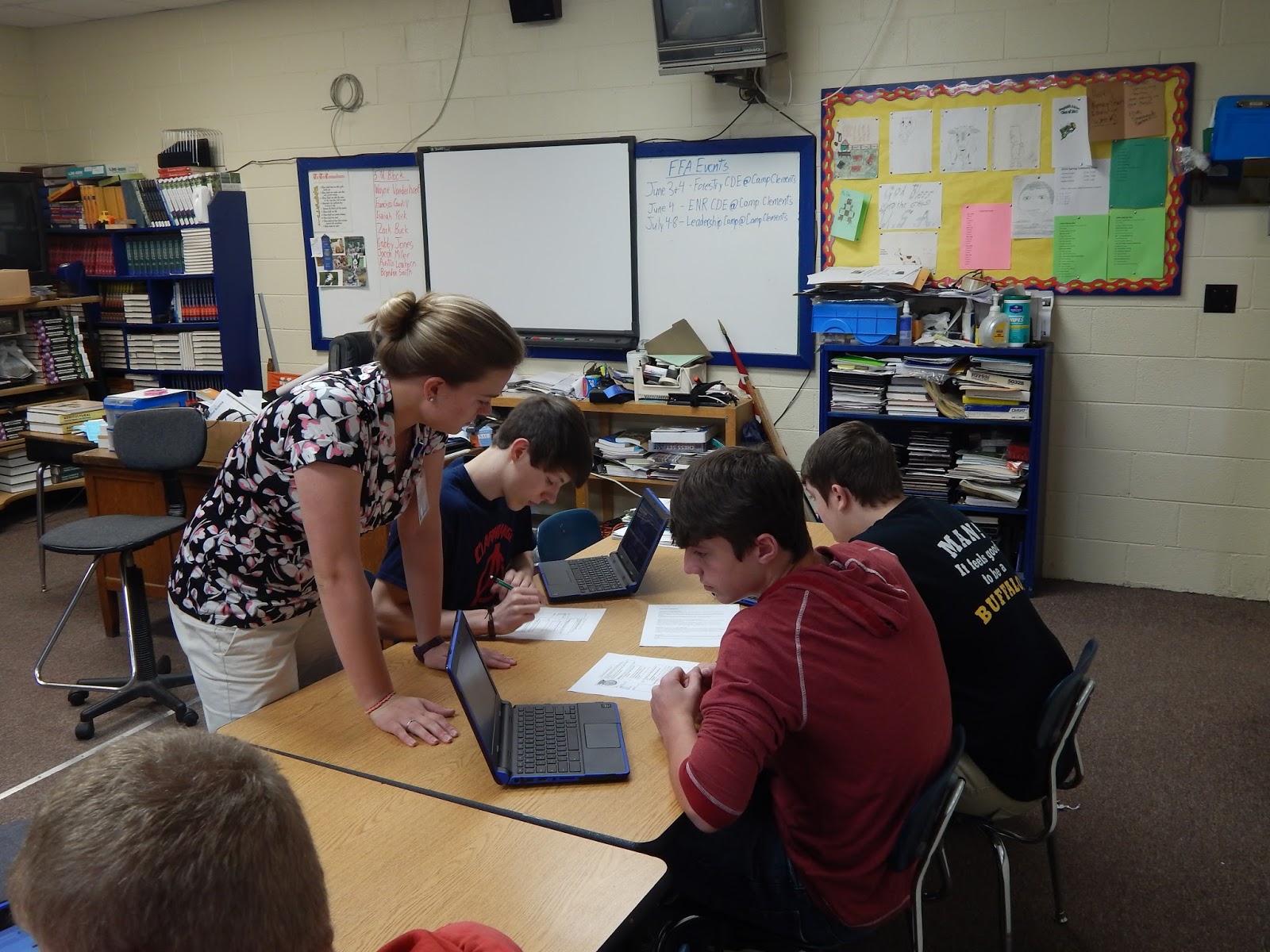
Though I never personally experienced the challenges Mr. Pat presented, I was thankful that I was able to understand the impact of the issue from learning about it in my rural sociology course. As you may be aware, the percentage of the population living in poverty has fallen, but rural areas still continue to be home to a large majority of the nation’s poor. This is due to many factors, but I feel the most important contributor that was pointed out by Mr. Pat is the rural brain drain. A brain drain is when many educated/professional people leave an area and move to another area that potentially provides better living conditions, more job opportunities, and better pay. In return, this leaves behind those without education or ambition, and prevents the area from growth, socially and economically. Due to this, sometimes school is a better place for a student than at home which is why Mr. Pat finds it important to make the experience a positive one. He does this by ensuring every opportunity presented to students is available to all. This provides students the chance to grow and better themselves.

As a future educator, I feel I have the ability to instill knowledge and ambition to create an intrinsic motivational experience while students are enrolled in my program. Overall, I hope that if I am provided the opportunity, I can create an impact in a rural school through passion and dedication like Mr. Lee and Mr. Pat. The stories shared with us were great reminders why we chose our future as an agricultural educator—for the students.


Follow along with our experience on Twitter by using #PSUAgEd2TN!  To learn more about starting on the path to having a career that makes a positive impact on the lives of students across the globe by becoming an agricultural educator, please contact the agricultural teacher education program at teachag@psu.edu. Follow us on Twitter at TeachAgPSU, on Facebook, or on our blog. 

Halee Wasson
2018 Student Teacher
Agricultural & Extension Education
@wasson_halee

Domestic Study Away Day 4: Learning by Doing #PSUAgEd2TN

Editors Note: The following is a reflective observation from different students participating in #psuaged2TN, our domestic study away program. Matthew Snyder (@snyder6878), a junior and member of #psuaged17, shares below.  This incredible event is made possible by the generosity of the CHS Foundation. 

On Thursday the Penn State Teach Ag! Society and I had the opportunity to visit Cookeville High School. After arriving at the school we were treated with great hospitality. A lunch was served and we shared fellowship with the current Cookeville FFA members.  Building relationships and rapport with students is extremely important, in a one-day visit, but more importantly in our own programs.  As we look at having our own programs it will be important to engage students and consider their viewpoint, this will help us as we create our own programs and class content. The main purpose of this trip is to broaden our professional network and create relationships, so our future students have better opportunities. I believe we accomplished one step of that at Cookeville. 

Facilitating our lesson at Cookeville High School

While at Cookeville, our group was able to do a little learning by doing.  We facilitated one of our lessons on American agriculture by region. We started off by giving the students the needed background information through a fun interactive warm up exercise, and then moved into the “meat” of the lesson. The students were placed in groups that correlated with a region of the United States and asked to research agriculture commodities in their respective region. We then moved to the creative portion, the creation of a commercial to promote agriculture in each region. We were blown away with how creative some of these groups were. One group even created a cow costume in the short time they were given. Every teaching opportunity has helped to develop us as professionally. We also learned a lot from team teaching this lesson. It requires a much higher level of communication when you have seven teachers running one lesson. One thing I took away from the experience was that I need to slow down my instruction and make sure all students understand what is expected of them.

Learning by doing, Matthew teaching part of the lesson.

After teaching our lesson and touring their facilities, we had the opportunity to talk engage in a small professional development training focused on dual credit courses within agriculture. One of the Cookeville Agriscience teachers, Ms. Jackie Vester has been very successful in implementing these types of courses.  Ms. Jackie Vester and Ms. Patrice Watson, Director of Early Post-Secondary Education at the Tennessee Department of Education led this conversation. She explained the differences, similarities, pros, and cons of both programs. This discussion gave our entire group a better understanding of what programs are out there for students and how they can be used to boost college and career preparation. After this meeting, I feel much more confidence in giving students advice on scheduling these types of classes. High school students do not always know what they need to know or what they want. As teachers we need to take them under our wing and point them in the right direction. After having this conversation, I feel much more confident in advising students on what dual credit and dual enrollments they should pursue and what it might be like to teach one of these courses. Students are extremely busy these days so they might need advice on time management as well.

Here is a Day 4 Video created by Rose Cowan!


Follow along with our experience on Twitter by using #PSUAgEd2TN!  To learn more about starting on the path to having a career that makes a positive impact on the lives of students across the globe by becoming an agricultural educator, please contact the agricultural teacher education program at teachag@psu.edu. Follow us on Twitter at TeachAgPSU, on Facebook, or on our blog. 


Matthew Snyder
2017 Student Teacher
Agricultural & Extension Education
@snyder6878

Friday, May 13, 2016

Day 3: Music City, Ag Programs, and Words of Wisdom #PSUAgEd2TN


Editors Note: The following is a reflective observation from different students participating in #psuaged2TN, our domestic study away program. Kayla Hack (@Hackkayla), a junior and member of #psuaged17, shares below. This incredible opportunity is made possible by the generosity of the CHS Foundation.

Bean seed germination lab. 
Nashville has always been known as Music City but after our time in the city I think we would all agree it is also home to innovative agricultural education programs.  These programs are committed to critical thinking and school wide academic improvement. The Domestic Study Away crew spent Day 3 visiting McGavock and Overton High Schools, both in the Nashville Metropolitan School System. Learning about the academy system and shadowing and teaching alongside talented teachers allowed our group to stretch ourselves both personally and professionally. 
Heather and her class at Overton High School. 

The Academy system around agriculture education in the Nashville Metro school system is unique. From the freshman career fair to choosing a pathway as a sophomore and shadowing professionals on the job, career and college readiness is at the heart of the Academy system at Nashville Metro. McGavock High School made the decision two years ago to replace physical science classes with agriscience classes, which allows every freshman to be in an agriscience class and an FFA member. At McGavock High School we were able to Shadow Ms. Mia Sullivan, Ms. Jennifer Smith and Mr. Westlee Walker  at McGavock and Ms. Rebecca Farrow at Overton. They allowed us to engage in labs, offered advice and helped answer our questions.   The stories about McGavock and Overton could go on, but I will leave you with my top 5 lessons learned at McGavock High School.

Top 5 “Lessons Learned” on Day 3:

Myself (Kayla) and Ms. Smith . 
1. Smile and be flexible. All of the teachers at McGavock shared this, either through their teaching or in conversation. Plans change, and as agriscience teachers we have to take a deep breath, adapt and be willing to change on the spot to get students where they need to be.

2. Be invested in. Ms. Smith invited me to go to her end of the year professional development review. This reiterated the importance of having a mentality of continued growth. I was able to witness what it looks like to be formally evaluated and reflect upon goals in a school setting. Being poured into as a teacher will allow me to pour into students.

3. Partnerships are key. Engaging in a round table discussion with Ms. Pamela Walker, Instructional Coach, Dr. Ricketts, Ms. Jennifer Smith, Ms. Mia Sullivan and Mr. Westlee Walker all teachers at McGavock High School and Mr. Crow a community and business  These stakeholders offered an example of what it looks like when partners come together to benefit a school, community and the future workforce.

Business partner and advisory board
encouraged us to stay connected

4. Ask for Help. Every stakeholder in our round table stressed the importance to us for agriscience teachers to ask for help, reach out, call people and pick their brain.

5. Don’t be Scared.it’s going to be a wild ride, but it will be worth it.” In her closing remarks during the round table Ms. Smith shared this exact phrase. Dr. Rickets agreed, and told us to jump in even though we still won’t feel ready. 

As we left McGavock High School the ideas and questions continued to percolate. This is a noble profession, but also a difficult one and one that I am still willing and ready to jump into whether it be in a Metropolitan area or a rural farming community. 

Follow along with our experience on Twitter by using #PSUAgEd2TN!  To learn more about starting on the path to having a career that makes a positive impact on the lives of students across the globe by becoming an agricultural educator, please contact the agricultural teacher education program at teachag@psu.edu. Follow us on Twitter at TeachAgPSU, on Facebook, or on our blog. 

Kayla Hack 
2017 Student Teacher 
Agricultural & Extension Education 


Thursday, May 12, 2016

Domestic Study Away Day 2: My Major is Better Than Yours... #PSUAgEd2TN


Editors Note: The following is a reflective observation from different students participating in #psuaged2TN, our domestic study away program. George Dietrich (@TheGeorge4H), a sophomore and member of #psuaged18, shares below.  This incredible event is made possible by the generosity of the CHS Foundation.
The DSA crew with President Aiken
Our day started off great aside from traffic problems, going to meet the Tennessee Farm Bureau. At first I thought we were going to meet with two members of the Farm Bureau, but instead we met the newly elected president, Jeff Aiken, along with what felt like half the staff. The tone of sincerity they gave us along with the southern hospitality made me realize how much they appreciated us visiting. Learning about everything Tennessee Farm Bureau does taught me the importance of building my network as an Ag Teacher. Partnerships with organizations like Farm Bureau provides incredible development in a successful Agricultural Department. Also the phrase, “Thank you for being an Ag Teacher,” was said repeatedly to us in our visit by all of them. They found value in what we want to accomplish. This was a moral boost for the entire group. After ending our visit with Farm Bureau we were off to Nashville to really learn about STEM.

Our second workshop was on STEM and agriculture. It was led by the legen- wait for it - dary Dr. Kris Elliot.  He taught us the  importance of incorporating STEM theories into the classrooms by giving us examples and engaging us in conversation. Then Dr. Chaney Mosely (another rockstar Ag Ed doctor) came in provided more context around how Nashville Metropolitan Agriculture Programs incorporate STEM and Agriculture. 


Dr. Elliot provided us numerous resources to engage in using technology. 

The crew with Dr. Elliot & Dr. Mosley
With four professors in one room they began talking about a lot of things that are near and dear to us as future agricultural educators. Getting a chance to get advice from four different stellar professors all with different agricultural education experiences was something that I would not miss in a life time. They told us different theories and experiences they had as high school agriculture teachers, then gave us practical advice on looking for the right high schools for each of us. They gave us a glimpse of what a really good ag program should look like. This is one of the few times I can say I have engaged in honest conversation and
discussion with four professors about career and major related topic, and it was refreshing.


Grand Old Opry fun!
To end a great day of learning, we convinced Dr. Foster to allow us the opportunity to bond as a team and go to the Grand Ole Opry. Yes that’s right the seven of us that went on DSA this year got the chance to see six artists in two hours (insert the jealousy of all our peers). We all learned a valuable lesson here: sometimes after a hard days work you need to relax as a team before you begin a the many hard days of work as a potential new teacher. The chance to relax is a good bonding opportunity that we could apply to our possible FFA Officer Teams.

These lessons we learned Tuesday were not something that could be taught in the classroom. The opportunity to learn the value of a strong network, the application of a new theory in the classroom, and the chance to learn from four great professors will develop us today as the stellar ag teachers of tomorrow. This is why our major is better than yours. The opportunities available to us this week have just begun and they will keep building down the road. Stay tuned for more details about our visits to Nashville Urban High Schools and our time in Cookeville, TN, let the Tennessee adventures continue!


Follow along with our experience on Twitter by using #PSUAgEd2TN!  To learn more about starting on the path to having a career that makes a positive impact on the lives of students across the globe by becoming an agricultural educator, please contact the agricultural teacher education program at teachag@psu.edu. Follow us on Twitter at TeachAgPSU, on Facebook, or on our blog.


George Dietrich 
2018 Student Teacher Candidate
Agricultural & Extension Education
Food Science