Showing posts with label Jeanne Case. Show all posts

Wednesday, October 31, 2018

Penn State Alum Returns to Pennsylvania

Jeanne Case returns to Pennsylvania to continue her journey as an Agricultural Educator! She is a #psuaged14 alum, and was employed in Walworth, Wisconsin (home of Kikkoman Soy Sauce) at Big Foot Union High School. Jeanne is currently teaching at Cumberland Valley High School in Cumberland County!

Jeanne applied for the position at Cumberland Valley because she has a strong interest in Agriscience and felt that the school would be able to support her curriculum. She also wanted to teach in a program that had two teachers, in an urban area, and closer to her family. At Cumberland Valley, Jeanne aspires to grow personally and professionally in the world of Agricultural Education. She states, "It is hard for teachers to find that work-life balance, but I really enjoy teaching. I will always be striving to find that balance to have longevity in the profession." 

Cumberland Valley encourages students from all different backgrounds and ethnicities to join FFA, and to know that they all have a place in Agriculture Education. Jeanne's goal is to continue this trend as she begins teaching at CV. She will succeed in this goal because she enjoys meeting new students and forming connections with them. "There is a place for everyone in agricultural science, you just have to take the time to get to know people and understand their strengths," exclaimed Jeanne. 

Her advice to those interested in Agriculture Education as a career is to talk to everyone and push yourself out of your comfort zone. "No one is an expert their first year (or fifth!). The necessary part is to keep pushing yourself and try to improve and be open to new ideas but not to work yourself into the ground and beat yourself up – you will burn yourself out."

We are excited that you are back in Pennsylvania, and cannot wait to see the positive impact you make on the lives of your students!


Luke Kerstetter
Communications Team Member
Twitter Handle: @Luke_Kerstetter
2020 Agriculture Education Student Teacher


Tuesday, April 8, 2014

Checking in with 2014 Student Teacher Jeanne Case! #psuaged14


Jeanne Case, 2014 Student Teacher

Jeanne Case (JRose_Case), a 2014 student teacher has come a long way to get to where she is today! From her countless hands on experience with the blog, her internship at the PA Farm Bureau, her involvement with the College of Agriculture, and so many more, she can honestly say that it all has prepared her for this experience. Jeanne is under the watchful eye of Mrs. Barzydlo in Dover Area High School in York County. Her everyday interactions with the kids and her enthusiasm to teach has made everything worth it for her.


Students in her auto
shop class

When Jeanne first arrived she had a lot of experiences to prepare her for this position. She has dealt with so many different people that have been in her life it is easy for her to deal with difficult situations. She was a part of Delta Theta Sigma (an agriculture fraternity), multiple clubs including Teach Ag! Society and CFFA, and her internship with the PA Farm Bureau. With all of the people skills she attained she was able to apply them at her student teaching experience! Jeanne stated, “Some students "tested" me by turning a blow torch on when they were behind a box and I could only see them from shoulders up. I calmly told them "no, no, turn that off" and apparently I passed the test because I didn't freak out and start yelling at them. At least, that is what they told Mrs. B. I didn't think it was a big deal, growing up with farm friends and dealing with my fraternity brothers, it didn't really phase me.”  At least all of her life situations ended up in her benefit!

Students working in the
green house

Jeanne was surprised to learn how much she was interested in teaching subjects that she had no idea she would love! She found out that she actually has a knack for teaching horticulture, which was funny to her because she hated making those lesson plans! She had the “ah ha moment” when she realized that she actually learned a lot of horticulture and plant science from her parents when she was growing up!

 Jeanne also made sure to leave some advice for the future student teachers! Her senior fall picked up so quickly that she realized she had to get her “Moodles” and assignments done quickly to make sure to be ready with all the lesson plans she needed to get done. She also stated, “Go to your cooperating center with an open mind. I did not meet any of my students except for one before I started teaching. They turned out to be AWESOME! I am glad that I got to meet them when I started teaching because it has let us learn together”
Jeanne and some of the students!


 “My students make my student teaching experience, if we did not have such a good time together, teaching would not be worth it for me.” Jeanne Case is going to do great things in the future and we can’t wait to check back in and see where she is and what she has been up to! 

To learn more about starting on the path to having a career that makes a positive impact on the lives of students across the globe by becoming an agricultural educator, please contact the agricultural teacher education program at teachag@psu.edu. Follow us on Twitter at TeachAgPSU, on Facebook, or on our blog!
Olivia Murphy-SweetStudent Blogger
Teach Ag! Avenger

Twitter Handle @OSweetMurph
2016 Agricultural Education Student Teacher 

Thursday, January 30, 2014

Distinguished Alumni Dr. MeeCee Baker

MeeCee Baker
Penn State College of Ag Sciences recently recognized Dr. MeeCee Baker as a Distinguished Alumni of the College. Dr. Baker graduated from Penn State in 1982 in Agricultural Education, which led her to more than twenty years teaching at both the secondary and post-secondary levels, the first female president of NAAE ( National Association of Ag Educators), appointed to executive office at the PA Department of Ag with educational outreach and now is a managing partner and chief operating officer for Versant Strategies. She is also the owner of a cow calf operation in Central Pennsylvania and was a faculty member at Penn State. To receive her award she spent three days on campus attending a banquet and talking to students in classes and open discussions. She went to one of the student teachers classes and shared stories and guidance on how to be a good agricultural teacher. She left the students with 9 trigger words that would help them remember things that are important to a teacher.


 Engage, engage your community and develop that advisory committee that Dr. Ewing talks about.

Communicate, parents, supervisors, school board and anyone else. Call the parents to introduce yourself and tell them when their child does something good. Keep the school board up to date with the happenings in the ag program. She would have her reporter develop a page of what the program had accomplished to hand out at the school board meetings.

Craft Brand. Who do you want to be? What is most important to you? She suggested to watch facebook and to make sure that you are displaying your best face publicly and to think about how you want people to think about you.

Bring ENERGY. It’s contagious, so if you bring it, others will get it!

Introduce Self. Make sure to introduce yourself to the office staff, kitchen, janitors, other teachers, principal, ect. Get a letter of recommendation from principal and superintendent. By being respectful to everyone it gets you respect.

Wait Two Days. If you get mad and just want to yell at someone or send a nasty email, write the letter, but don’t send it for two days. If after those two days you still want to send it, send it. Turn bitter into better.

Raise Profile. Celebrate big ag events and invite representatives and senators to the events. Utilize the extension and make sure to participate in community service.

 Connect. Every day connect with your students, greet them at the door, call on them. Don’t let them be INVISIBLE!

Take/ Accept. Accept every single one of your students. Make your classroom so inclusive that you cannot tell the number one student from number fifty. If you accept students it will also attract new students.


It was very interesting to listen to her nine trigger words and tips for success. It really tied the senior agricultural education classes together and made it possible to see them applied in real life. She shared some of her best moments teaching, and some of her worst with the class which made it more real for the students. As an agricultural educator, there is the ability to change lives and help students grow as individuals.

To learn more about starting on the path to having a career that makes a positive impact on the lives of students across the globe by becoming an agricultural educator, please contact the agricultural teacher education program at teachag@psu.edu. Follow us on Twitter at TeachAgPSU, on Facebook, or on our blog!


Jeanne Case
Student Blogger
2014 Dover HS Student Teacher
Twitter: JRose_Case

Wednesday, December 11, 2013

2014 Student Teachers (#psuaged14) reflect on their Micro Teaching Experience at Central Mountain

A front view of the high school. Photo Creds: Chris Knight,The Patriot-News
A few weeks ago the 2014 student teaching cohort traveled to Central Mountain Area High School to apply what they have been learning throughout the semester. It was an interesting time for most, being able to see what worked and what didn't work, with all the theories and practices we have been learning throughout the semester. During the three day teaching period, we approached the situation recognizing that we had free use of trial and error to see how our theories worked, and if they didn't, we would never have to go back there or see the students again. We have been working a lot this year to have a growth mindset. Part of that is to take what you did well and what you did badly and learn from it. Change the bad in the future and grow from the experience. Nothing is a bad experience; it is always a learning experience that can help push you in the right direction.

As my cohort reflects on our experiences at Central Mountain, here are some of the things that we did well and others that we need to improve on.

Valerie Laub prepares for a class

Meagan Slates was happy with her student teaching experience! To challenge herself, she taught a welding class where students completed a hook project. Meagan started in the classroom the first day to really go over what they were doing and why its important. On the second day, she broke the class into three groups so they would be able to travel around the shop, complete their project in smaller groups and be safer. Meagan demonstrated at each station and asked many questions to make sure that the students really knew what was going on.  She could tell they were getting a little annoyed with all the questions, but she wanted to make sure everyone stayed safe. On the the third day, the students actually got to work at the stations and everything went well. Overall, Meagan was really happy with how her micro teaching experience took place and is excited for her future plans of student teaching. You can read her blog here.


Allison Hoover facilitating an activity outside

Allison Hoover ended her blog with some “concepts for success” such as: to set the stage by creating a felt need for the content, don’t second guess yourself, keep directions clear and concise, and to ask high order questions to get them thinking. She also said "teach for many years.. then maybe you’ll get it down".

I completed student teaching on Wildland Forest Firefighting. I had a class of nine senior boys and really enjoyed working with them. However, I did not keep them engaged enough. It was a very interesting experience as each day the class responded differently.  On the first day they talked too much, while on the second day, a student fell asleep.  On the last day, I had a really awesome bellwork and interest approach but lost their attention as the class went on. I learned many lessons for my future student teaching experience like carrying out lesson plans and teaching from PowerPoints, but especially preparation. Preparation is everything and can really help you out. I was really prepared with the stuff that I had since I brought some equipment that the firefighters really use, but I did not have enough engaging activities and I kept losing my students. However, this is a learning experience and it served its purpose as I learned a lot and I will improve in the future.

My student teaching cohort all had good experiences and learned a lot during our time there. We were able to learn from this experience and change things for our LifeKnowledge lesson at our cooperating school that we are student teaching at. Teaching is one of those things that just takes a while to become good at. It takes a while to come to a point that you feel comfortable and this is something that people really need to keep in mind. You cannot enter the field thinking you will be perfect right away. You need to give yourself room to grow.

To learn more about starting on the path to having a career that makes a positive impact on the lives of students across the globe by becoming an agricultural educator, please contact the agricultural teacher education program at teachag@psu.edu. Follow us on Twitter at TeachAgPSU, on Facebook, or on our blog!


Jeanne Case
Student Blogger
2014 Dover HS Student Teacher
Twitter: JRose_Case

Monday, December 9, 2013

Dupont National Agriscience Preservice Teacher Program from NAAE

Recently during the 2013 National FFA Convention, sixteen students from across the nation chose to develop themselves professionally with the help of Dupont and NAAE. These sixteen students from fourteen universities applied and were accepted into the National Agriscience Preservice Teacher Program, created especially for students that were currently student teaching or would be teaching in the upcoming spring or fall.

Two students from Penn State were selected, Jessie Ross (@JessieLeeRoss) and myself (@JRose_Case). To be selected into the program, we had to answer a variety of short answer questions, submit a resume, and have a letter of recommendation. We were honored to have been selected for the opportunity.

The preservice program was funded through Dupont Office of Education and facilitated by the National Association of Agricultural Educators coordinated through Alissa Smith. 

The teachers leaders of the program taught the program by example, going through the different areas and subjects in which inquiry based learning could occur. We learned how to keep and grade a notebook as we recorded different lab activities such as, how to write hypotheses, find out if double stuffed oreos are really double stuffed, photosynthesis and respiration, grizzly greenhouse murders, and cattle calls.
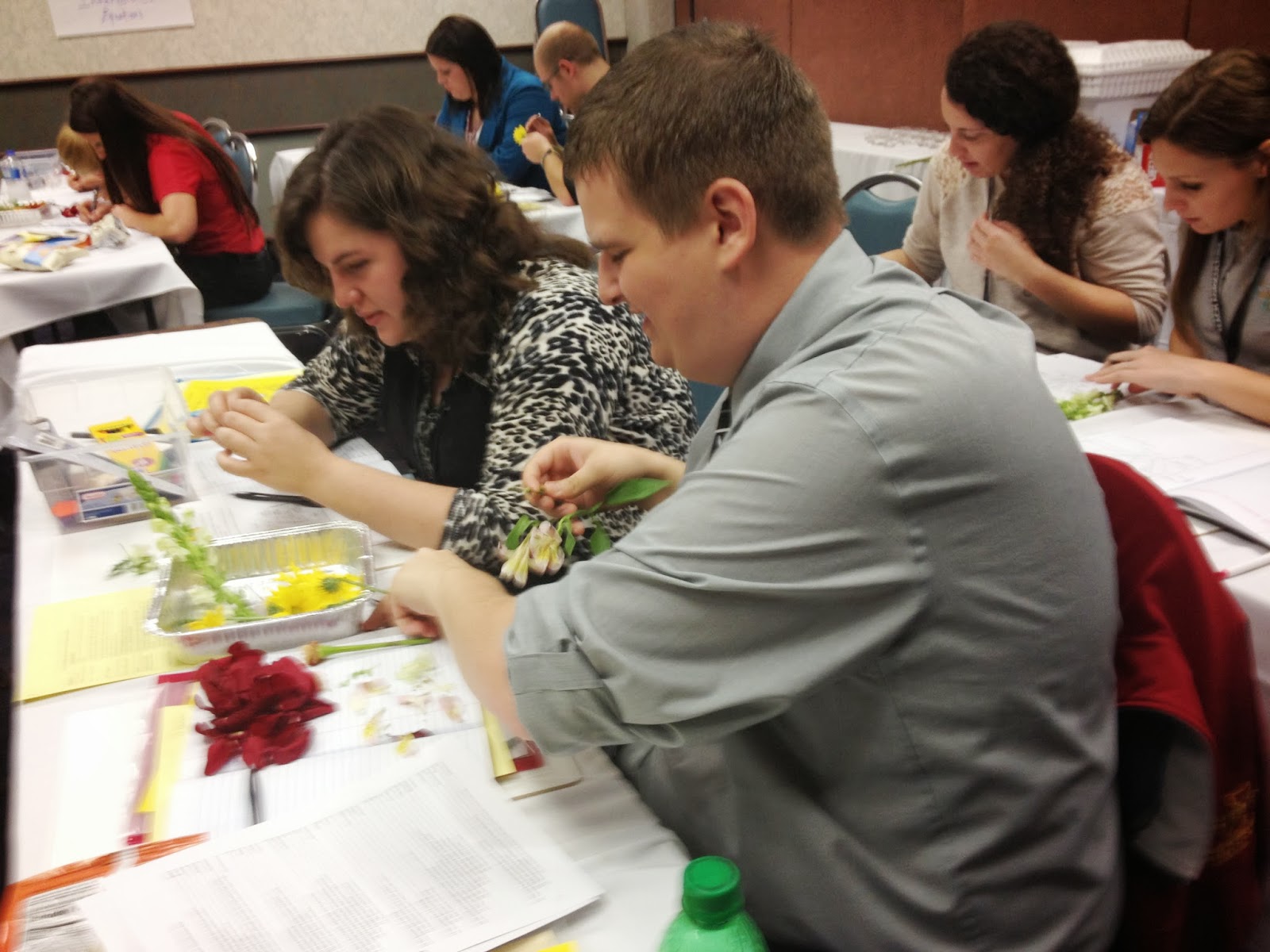
Jessie Ross trying to identify flowers to find the "killer".
Inquiry based instruction is having students do mental work rather than the teacher unloading information in front of the students, and it also helps them to think critically. It is not a passive form of teaching and reengages students into learning. Instructional strategies that we learned included having the students write reflections in their notebooks in a different color; for example, they can write definitions in a different color. There were also partner highlighting where two students read the same article and had different color high lighters. When they are done reading and highlighting, they discussed what they highlighted and their partner will highlighted what the other person highlighted on their own paper. This got them engaged in a discussion of what they thought was important and why. It also makes them not miss anything important because they will have two people on one paper.


Jeanne Case on left, working together to discover the photosynthesis cycle
They also gave us classroom management tips. My personal favorite was stamps to grade a notebook. As students complete different parts of their project, they have to get approval from the teacher in the form of a stamp. After they have gotten the stamp, they may move on and continue with the classwork. This definitely beats dragging home 20 notebooks from one class, and it also checks understanding throughout the lesson to make sure the students really know what is going on. Question cards were another avenue since it limits student questions. They can only as ask many questions as they have cards.. and yes, may I go to the bathroom does count. This makes them think more rather than just asking for it to be spoon fed to them when they need help. Lastly, a way to get students into group is to hand out famous pair cards. Students will match up with their partner, an example being Louis Lane and Superman.

Jessie reflected on the experience and said, "I 'm really glad that I had this opportunity to take part in the Preservice Program on inquiry based instruction, learning how to teach students both material and more importantly how to think on there own. Along with the instruction, the instructors also shared great classroom management tips to still keep the room under control without limiting your students, as well as grading tips so that the lessons still have value to the students....I would have never thought that students would work so hard to get their paper stamped until I saw fifteen college students and myself's in action. It truly was a great experience and would really encourage next years student teachers to fill out the application and take part."  

Besides from learning a lot about inquiry based instruction, we also got to meet and work with our peers from across the country. A girl that I talked to was already student teaching in South Dakota and had a job lined up for January, which I thought was really impressive for a fast turnover rate.

It was great to learn more about another form of instruction, especially before student teaching where mistakes are allowed to happen and you can really figure out what works and doesn't work for you. Also, classroom management is necessary to learn, because it is necessary everywhere. Lastly, it is important to participate in professional development events, because as people always say…. It is important to not invent the wheel twice!

To learn more about starting on the path to having a career that makes a positive impact on the lives of students across the globe by becoming an agricultural educator, please contact the agricultural teacher education program at teachag@psu.edu. Follow us on Twitter at TeachAgPSU, on Facebook, or on our blog!


Jeanne Case
Student Blogger
2014 Dover HS Student Teacher
Twitter: @JRose_Case

Wednesday, August 28, 2013

First Days of School!!!

On the first day of school people, whether they admit it or not, always feel some sort of emotion towards it. Whether it is the excitement of the adventure of starting another year or dreading that alarm clock blaring that they know will come. I felt excited and anxious as it is my last first day of school as a student in the foreseeable future. How do I define myself after this year, since I have been a student for the majority of my life?

But I also saw the flip side as my teacher friends, new and seasoned, post facebook statuses about how excited they are for the first day of school and how ready they are to teach agriculture. Nicole Weaver from Twin Valley High School posted a status about starting her 10th year of teaching and expressed her excitement for the new school year but also thinking about her previous students that she has had and all the different stages of life they are in. Tons of previous students posted on it thanking her for being their Ag teacher and saying what they were doing that day. Some are starting grad school, some are going into teaching careers themselves and asking for advice. It is great to see how one person can affect so many people, and that it stays with them many years down the road.

Mike Woods at Cumberland Valley High School stated that he was excited about his new teaching partner, Darla Romberger who recently graduated from Penn State in Ag Ed. He also said that he is ready to keep helping their program grow and expand and continue to change lives through agricultural education.

Other teacher status yesterday on my newsfeed came from Kristy Brubaker who just graduated from Penn State this spring. She said that today was the best day of school that she has ever had, and is excited about the classroom and the students.

None of these teachers had anything negative to say and are excited about ‘creating positive agents of change’ which is a phrase commonly used in the Penn State Ag Ed Program. Seeing these other teachers' successes, makes me more excited about when my role will be reversed, and I will be standing in front of the classroom rather than behind the desk as a student.  I know that myself and the rest of the 2014 student teachers are up for the challenge that follows that first day of school and are ready to be Penn State Ag Ed ROCK STARS!

To learn more about starting on the path to having a career that makes a positive impact on the lives of students across the globe by becoming an agricultural educator, please contact the agricultural teacher education program at teachag@psu.edu. Follow us on Twitter at TeachAgPSU, on Facebook, or on our blog!


Jeanne Case
Student Blogger
2014 Dover HS Student Teacher
Twitter: JRose_Case

Monday, August 26, 2013

Janae Herr as a National Collegiate Ag Ambassador

Janae Herr, a sophomore at Penn State, heard a lot about the National FFA Collegiate Agriculture Ambassador Program from Jill Gordon (2015 Student Teacher; @jillianpsu) and Dr. Foster (@FosterDanielD) as they flew to Arizona at the beginning of the summer for the domestic study tour of Agricultural Education programs in other states (Written about here: http://teachagpsu.blogspot.com/2013/07/a-domestic-study-abroad-teach-ag.html).

Group picture outside of the Syngenta Crop Lab
After what seemed like the blink of an eye, Dr. Foster made plans for her to present to class of secondary Navajo students in Arizona and had her fill out the application for the Collegiate Ag Ambassador position on his iPad while they were on the trip. The application consisted of her resume, five short essay questions and a five minute YouTube video of her presenting to an audience, which she did at the Monument Valley High School where she gave the 10th grade Vet. Science class a lesson on why they should teach agriculture. After hearing back from National FFA, Janae was booking plane tickets and heading down to Greensboro, North Carolina!

Syngenta's new Greenhouse/ Crop Lab
they toured
In North Carolina, Janae was joined by 19 other Ag Ambassadors from across the nation. The National FFA Collegiate Agricultural Ambassador team has three corporate sponsors – Syngenta, BASF, and CSX. Syngenta’s headquarters are in Greensboro, NC which is where their training was held during the week.  The Ag Ambassadors four days of training included a lot of logistical discussions, greetings, presentations and networking from and with Syngenta staff. The ambassadors also had tours of Syngenta facilities, team-building activities and rigorous facilitation training from the National FFA staff. Despite all the hard work the Ambassadors had to put in, they still took a little downtime to watch the hometown Greensboro Grasshoppers play baseball.

As an Ambassador, Janae has to complete 30 hours of presentation time. The presentations can involve any part of the agricultural industry and to audiences of any demographic. During the training, the ambassadors were given some lesson plans to use in the presentation. The lesson plans had topics ranging from Food Safety to Advocating for Agriculture or Dairy to GMO’s as starters but they were also asked to design some of their own lessons to share with their teammates at the winter training in Jacksonville, FL with CSX. Janae is excited about getting started because she wants to positively reflect “an industry that has a very important story to tell.”

Syngenta employee round table discussion
about all things agriculture
Looking forward, Janae is excited for not only the professional development and networking opportunities that the team provides but also how this experience will make her a better advocate for the agricultural industry. She is thankful for all the resources that she has been given, which will help her out as she continues to peruse a career in Agricultural Education. Janae said that “that week in Greensboro was a fantastic and refreshing reminder to never stop desiring to learn new things”. She was also very happy to have walked away from the experience with 19 new friends and a lot more information about the agricultural industry!

To learn more about starting on the path to having a career that makes a positive impact on the lives of students across the globe by becoming an agricultural educator, please contact the agricultural teacher education program at teachag@psu.edu. Follow us on Twitter at TeachAgPSU, on Facebook, or on our blog!


Jeanne Case
Student Blogger
2014 Dover HS Student Teacher
Twitter: JRose_Case


Thursday, August 22, 2013

Getting my intern on with Pennsylvania Farm Bureau!!

In front of the White House in DC
Hello everyone, I am Jeanne Case, 2014 student teacher and the 2013 Student Teach Ag! Blogger. This summer in addition to blogging and taking a summer English class, I was an intern at the Pennsylvania Farm Bureau for the Friends of Agriculture Foundation. I worked with the non-profit educational part of the Pennsylvania Farm Bureau and had lots of projects such as developing the take home activity for Ag Progress Days and the game that the kids played on-site. I also helped out with the FACE youth conference which I posted a blog about earlier in the summer; Greg Peterson was the keynote speaker and talked about advocating for agriculture.

Agriculture in the Classroom was the other major conference that I helped run this summer at Penn State.  In addition to the projects with the Foundation I also got experience in the Member Relations Division. Attending the membership kick-off conference, working membership in my County and traveling around Adams County with a Regional Organization Director (ROD), kept me busy.  I was able to travel to Washington, D.C. and Harrisburg to see what our lobbyists do, as well as attend the Policy Development Kickoff meeting and the Commodity meetings with the third division, Government Relations.

A student at FACE conference
 giving a thumbs up
The FACE (Fueling Agriculture and Cultivating Excellence) conference was easily my favorite week at Pennsylvania Farm Bureau, even while working 27 hours of over-time! It was great to watch the students come in shy on Monday, then not want to leave all the friends they had made  when it was time for them to depart on Friday.  I was in charge of the Swine Commodity group with Brittany Courson, the Regional Organization Director. Our group was responsible for making a video and Facebook page to advocate for the swine industry. The students gained a new perspective; they do not typically need to explain the importance of their industry. The students also had to write bills to send in to the FACE version of the House of Representatives where they were discussed.

Some of the female employees at the FACE conference
The students in my group kept asking me where I was going to be student teaching and looked sad when I said Dover High School; none of them go there. I asked them for tips on how to be a good student teacher and they said to not make my students feel dumb. The students said it’s not good for the student teacher to talk over their heads and then get frustrated when the students don’t understand the lesson because the student teacher isn't explaining it well. I am also supposed to be strict…but not too strict, and BE EXCITING! If I don’t move around the classroom and instead just stay in one spot and am really boring the students won’t pay attention and will fall asleep. It was really great to hear that from a student’s perspective as I will try my best to not be boring in the classroom!


Attendees and volunteers at AITC
AITC, Agriculture in the Classroom is a conference for teachers to attend to get graduate program and/or ACT 48 credits. It is a whole week focused on different aspects of agriculture ranging from mushrooms, to livestock, to trees, gardens and bio-energy, to name a few. Teachers from across the state attend, teaching a variety of subjects and ages. This was a super great experience, to be able to meet such as diversity of teachers. A math teacher told me to incorporate music into my classroom, for instance to not call on someone until a song or music clip is done so the students will have more opportunity to think and form an answer. Or to have a sound clip on almost every slide to act as an attention grabber and make the students pay closer attention to what is on a screen. Music can also be used as a reward if the students are working well on something – and it can be taken away as a punishment.

When I traveled around with Owen Weikert, the Region 3 Regional Organization Director, all day in Adams County, I saw a lot of aspects of agriculture that I was not previously knowledgeable about. I was able to tour an apple orchard.  This orchard provides most of the apple tree starts on the east coast, stretching even to Michigan. I had no clue that you could not plant apple seeds and that you had to graft the variety you wanted on root stock. My student teaching school students have an apple judging day;  it is good that I will at least have a little background knowledge! I also got to tour a dairy farm and see their milking parlor, as well as look at Mason Dixon Dairy. During the meeting in the evening I got to meet a lot of farmers in the area and even met a woman who writes about agriculture for different publications; I am sure she will be a very good contact in the future.

Interns with a PSU Alumni
Pennsylvania Farm Bureau also treated their interns very well. One benefit was to spend a night in Washington, DC. While we were there we met with all of our congressmen as well as a senior policy person in the senate, (who is a Penn State Ag Sciences Alumna). Going to all the meetings we walked  or rode trains in tunnels underneath the buildings, even to the capital, making it very hard to keep my bearings. I know that I would not have ever been able to experience anything like this if it wasn't for PFB. To wrap up the trip we went to the American Farm Bureau office and got a tour of their facilities and met a lot of important people. Unfortunately their internships are not paid, but even so, that still may be a great experience/opportunity for next summer!

Interns on the Capitol steps in Harrisburg
Harrisburg was great to see, as so many of the governmental  issues that directly affect our farmers begin there. We got to meet another Penn State College of Ag Science alumni who helps to make sure the voting members know about agriculture. We talked about her position and the different issues she deals with on a daily basis. It was also great to just tour the capitol since I had not been there since 4th grade and it truly is a beautiful building, something that Pennsylvania should definitely be proud of. 

All in all this was a great internship experience. I went into it thinking that I knew what to expect as I have known multiple people who had gone through the program before, but it really reached above and beyond those expectations. The experience I got, and the connections I made are truly irreplaceable. Everyone that I worked with was really helpful and wanted to watch us interns succeed in our lives. I know that they are sad to see us leave, but also happy that there are three women that are just starting to enter the workforce with a strong passion for agriculture.
Interns in front of the building. Thank you PFB!
To learn more about starting on the path to having a career that makes a positive impact on the lives of students across the globe by becoming an agricultural educator, please contact the agricultural teacher education program at teachag@psu.edu. Follow us on Twitter at TeachAgPSU, on Facebook, or on our blog!


Jeanne Case
Student Blogger
2014 Dover HS Student Teacher
Twitter: JRose_Case

Gaining Global Competency and Applied Research Skills: Bryanna Kenno's European Adventure

Study abroad group in the English Gardens in Munich, Germany
Bryanna Kenno, a junior at Penn State, was chosen to help Laura Rice (@laurasankeyrice) this summer with her Ph.D dissertation work in Sweden. She was recommended for the position by Dr. Foster, her adviser. Bryanna was eligible for the position because she is majoring in Agricultural Extension and Education with a minor in International Agriculture, as well her good grades and involvement in extracurricular activities. Bryanna fit the bill perfectly and was ready to travel to Europe.

To get to Europe, Bryanna traveled with a group of eight students and two adults from Penn State Altoona as they made their way to Germany for a short term study abroad experience. Bryanna arrived in Germany in early May to complete the short course study abroad, and then left the group to travel to Sweden by herself. Bryanna stayed in Sweden for about three weeks and said that that travel experience was definitely different, as she had to deal with delay or gate changes which can be scary in a foreign airport alone.

Group representing Penn State at the Ritter Sport factory in Waldenbuch, Germany
When she was in Germany with the Altoona group, the study abroad class focused on agricultural production systems. The class got to tour three dairy farms, the Ritter-Sport chocolate factory, a brewery, a winery and vineyard, a German McDonald’s, and the Viktualien Market in Munich. Sweden didn't have as many sightseeing opportunities but Bryanna spent a few days exploring the city of Uppsala then joined Laura to tour the Viking Burial Grounds. She and Laura also went to the coast of the Baltic Sea with a couple that Laura had met at the University.

Besides traveling across Europe, Bryanna also did some work while she was there. Bryanna helped Laura research effective instruction in post-secondary agriculture courses, specifically working to develop operational definitions of teaching practices of award winning agricultural educators at Sveriges lantbruksuniversitet, the Swedish University of Agricultural Sciences (http://www.slu.se/en/) She accompanied Laura to interviews with faculty, entered data into spreadsheets and completed a review of literature. Bryanna was able to work with faculty members and students of the college.
Viking Burial Grounds in Gamla Uppsala, Sweden. Grounds date back to the 1500's and Vikings were usually cremated and buried in a tomb underneath the mounds. 
With a more globalized view on agriculture, Bryanna said that the traveling she did and her research experience has impacted her as a future educator in numerous ways. She had the opportunity to experience agricultural systems in Germany and interact and discuss agriculture with students her age from both countries --- students from Hohenheim University in Germany and students from SLU in Sweden. When she got home she felt a sense of reassurance and knew that entering the field of agricultural education was the right decision. In both Germany and Sweden their secondary schools don’t have agricultural education classes and the students that Bryanna met were amazed that so many American high schools offer agricultural programs. This made her appreciate agricultural programs and FFA in a whole new way. “I also knew that I made a great decision by conducting undergraduate research involving agricultural education because the field means so much to me. I want to leave a lasting impact on my future students and all of my experiences in Europe will allow me to do this.”

Bryanna starts undergraduate research in the fall that will partially stem off of Laura’s work from this summer. She will be researching how student’s evaluations of classes in the College of Agricultural Sciences affect the way professors teach the classes in the future.

To learn more about starting on the path to having a career that makes a positive impact on the lives of students across the globe by becoming an agricultural educator, please contact the agricultural teacher education program at teachag@psu.edu. Follow us on Twitter at TeachAgPSU, on Facebook, or on our blog!


Jeanne Case
Student Blogger
2014 Dover HS Student Teacher
Twitter: JRose_Case


Tuesday, August 13, 2013

2013 Teach Ag! Society Essay Event Results

Austin Young
 and 2013 student teacher Mackenzie McCollum
The Teach Ag! Society essay contest has been a part of the Pennsylvania State FFA Convention for the past four years. Students entering the contest must plan, design, and teach a lesson about agriculture to an agricultural class of their choice. Their teacher helps them with their lesson plan and guides them along the process of being a teacher for a class. The student then has to write an essay about their experiences during the process. To enter the contest the student submits their essay, lesson plan and pictures, which are graded by a group of selected individuals at Penn State. The top four contestants are announced before the State Convention registration then the final placing is announced at the Pennsylvania State Convention in June.

Facilitators at the Wii Night after the announcement of the winners
This past June, the contest saw a record number of participants with 45 applications sent in. Meagan Slates, Presidents of the Teach Ag! Society, was in charge of the essay contest this year. She comments that “A lot of the feedback that was given in the essays was that the students really looked up to their teachers and wanted to give it a try. I was surprised at the repeat number of participants from last year. With the help of their teachers most of the students really enjoyed teaching a class. All the students essays were great and choosing a winner was really difficult!” Meagan is a senior in Agriculture Education and as she enjoys advocating for agricultural education, she thinks that getting students excited about teaching is really important.

Some of the students entered the essay contest because they wanted the experience teaching or they wanted to see what it felt like to be in their teachers shoes. Regardless of the reason the students entered the contest, they definitely learned a lot about the teaching process.

Austin Young teaching the class
Austin Young, from Central Columbia High School is the first place winner this year. This is an excerpt from his winning essay:

“Agricultural education is vital to our nation’s youth because it teaches students 21st century thinking skills which will aid them in being more employable in today’s increasingly competitive career market. In order for one to realize how agriculture affects every facet of society, agricultural literacy at an early age is essential. That is why society needs innovative, agricultural educators within our school systems.” 

Austin said that entering the contest gave him an opportunity to explore the career and was supported by his teachers Mr. Doug Brown, Mr. Curtis Turner, and his student teacher at the time Ms Mackenzie McCollum. Winning, he said has “reassured me that the career of being an Ag educator is one of the most important jobs in a society that would not be able to make it through one day without agriculture.” He also pointed out again that there is a shortage of agricultural educators nationwide and the need for Ag educators is more important now than ever. “ That is why this contest is so important. It gives students the opportunity to see what it is like to be an agricultural educator, which will hopefully propel them into a career of teaching America’s youth about agriculture.”

Katie McLaughlin and Victoria Herr in their
Teach Ag! shirts from the essay contest.
Victoria Herr, a senior at Penn Mannor High School, entered the contest because she wants to be an agricultural teacher some day. She thought that by entering the contest she would get a good feel for what being a teacher requires from an individual. “This contest taught me a lot about the skills needed to be a teacher such as writing good lesson plans, keeping the students engaged, and being prepared to answer any questions they may have. It also taught me that not all students are on the same learning level and as an ag teacher you must ensure that everyone is following along at a good pace for themselves”. 

Another student, Katie McLaughlin from Juniata High School entered the contest because at one point she had wanted to be an agricultural teach but her plans have changed. Although Katie will not be a teacher she will “always be teaching in the form of avocation.” Katie also said that the contest taught her a lot about what agricultural teachers do. Her teacher at Juniata is a part of a one teacher program with 110 kids to keep track of. She also has 11 different classes to teach in an 8 period day, all with different lesson plans. “I believe all teachers face challenges and we as students need to realize that our teachers truly want what is best for us. The essay made me realize how much Mrs. Morgan cares and it taught me to say thank you for everything she has done for our program.”

The top four winners of this years event were:
1st Place Austin Young, Central Columbia HS,
2nd place Amber Gabel, Newport High School,
3rd Place Lisa Boltz, Northern Lebanon High School, and
4th Place Victoria Daltroff, North West Area High School.

Meagan Slates wishes to continue increasing the contests and hopes to break the 45 entry record next year. Please keep an eye out to be ready to participate and apply next year! The Nation Needs You!

To learn more about starting on the path to having a career that makes a positive impact on the lives of students across the globe by becoming an agricultural educator, please contact the agricultural teacher education program at teachag@psu.edu. Follow us on Twitter at TeachAgPSU, on Facebook, or on our blog!


Jeanne Case
Student Blogger
2014 Dover HS Student Teacher
Twitter: JRose_Case