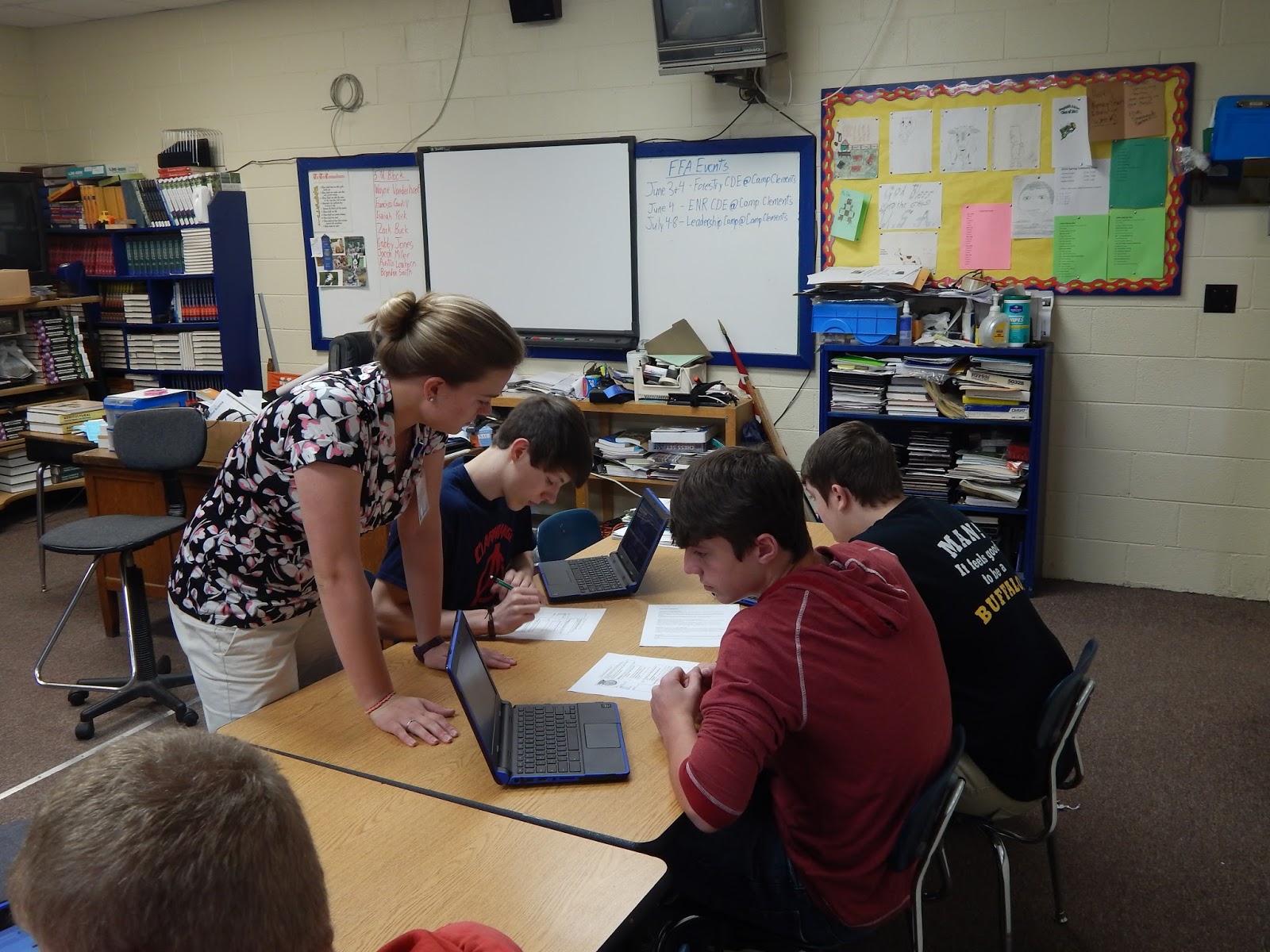
Editors Note: The following is a reflective observation from different students participating in #psuaged2TN, our domestic study away program. Halee Wasson (@wasson_halee), a sophomore and member of #psuaged18, shares below. This incredible event is made possible by the generosity of the CHS Foundation.
As I reflect upon the last day Penn State
Teach Ag! Society explored Tennessee’s Agricultural Education Programs, I find
myself referencing the following quote: “Never stop learning because life never
stops teaching.” As a student I am constantly learning; which is why I find
education valuable, since I can take what I learn in the classroom and connect
it to an experience I am participating in at that time.
 On Friday May 13th, Penn State
Teach Ag! Society traveled to Clarkrange High School in Clarkrange, Tennessee
to explore their Agricultural Education Program. Clarkrange High School is
located in the small community of Clarkrange in Fentress County. After visiting
metropolitan schools earlier this week, this visit was a great way to wind
down, and participate in a rural school experience. The size of CHS’s student
body is around 300 students, with an average graduating class size of 60
students. Although small, Clarkrange’s Career Technology Education (CTE) program
provides many opportunities for their students to explore and expand their
knowledge in career fields related to their interest. We were given a tour of
all these CTE programs by Mr. Lee Little (referred to as Mr. Lee); who was the
past Agricultural teacher, but is currently serving as the director of the CTE
program. Although we enjoyed learning about all their programs, our
biggest interest was at our last stop of the tour—the Agricultural Education
Program.
On Friday May 13th, Penn State
Teach Ag! Society traveled to Clarkrange High School in Clarkrange, Tennessee
to explore their Agricultural Education Program. Clarkrange High School is
located in the small community of Clarkrange in Fentress County. After visiting
metropolitan schools earlier this week, this visit was a great way to wind
down, and participate in a rural school experience. The size of CHS’s student
body is around 300 students, with an average graduating class size of 60
students. Although small, Clarkrange’s Career Technology Education (CTE) program
provides many opportunities for their students to explore and expand their
knowledge in career fields related to their interest. We were given a tour of
all these CTE programs by Mr. Lee Little (referred to as Mr. Lee); who was the
past Agricultural teacher, but is currently serving as the director of the CTE
program. Although we enjoyed learning about all their programs, our
biggest interest was at our last stop of the tour—the Agricultural Education
Program.
During our time in Clarkrange’s agriculture
classroom we were able to engage with students and teach them about the many
opportunities and careers in the agricultural industry. With the class sizes
being no larger than 14 students, we taught our lesson in pairs of two. This
provided the other Penn State teacher candidates who were not teaching time to
engage in discussion with Mr. Pat Little (referred to as Mr. Pat); who is the
current agricultural teacher. Mr. Pat is an amazing individual who is never
short of words for the subject he is passionate about – teaching agriculture!
Passion and dedication is truly the driving force behind the success of this
program. Every question we presented to
Mr. Pat or Mr. Lee was answered with stories of their personal experiences
pertaining to the subject matter. These men truly devote themselves to
bettering their students, school, and community. They have many successes that they
can claim; however, Mr. Lee pointed out, “Although successes are important,
failures are just as important.” Like all programs, Mr. Pat admitted to
challenges that are presented in his rural school and community.
 Though I never personally
experienced the challenges Mr. Pat presented, I was thankful that I was able to
understand the impact of the issue from learning about it in my rural sociology
course. As you may be aware, the percentage of the
population living in poverty has fallen, but rural areas still continue to be
home to a large majority of the nation’s poor. This is due to many factors, but
I feel the most important contributor that was pointed out by Mr. Pat is the
rural brain drain. A brain drain is when many educated/professional people
leave an area and move to another area that potentially provides better living
conditions, more job opportunities, and better pay. In return, this leaves
behind those without education or ambition, and prevents the area from growth,
socially and economically. Due to this, sometimes school is a better place for
a student than at home which is why Mr. Pat finds it important to make the
experience a positive one. He does this by ensuring every opportunity presented
to students is available to all. This provides students the chance to grow and better
themselves.
Though I never personally
experienced the challenges Mr. Pat presented, I was thankful that I was able to
understand the impact of the issue from learning about it in my rural sociology
course. As you may be aware, the percentage of the
population living in poverty has fallen, but rural areas still continue to be
home to a large majority of the nation’s poor. This is due to many factors, but
I feel the most important contributor that was pointed out by Mr. Pat is the
rural brain drain. A brain drain is when many educated/professional people
leave an area and move to another area that potentially provides better living
conditions, more job opportunities, and better pay. In return, this leaves
behind those without education or ambition, and prevents the area from growth,
socially and economically. Due to this, sometimes school is a better place for
a student than at home which is why Mr. Pat finds it important to make the
experience a positive one. He does this by ensuring every opportunity presented
to students is available to all. This provides students the chance to grow and better
themselves.
As a future educator, I feel I have the
ability to instill knowledge and ambition to create an intrinsic motivational
experience while students are enrolled in my program. Overall, I hope that if I
am provided the opportunity, I can create an impact in a rural school through
passion and dedication like Mr. Lee and Mr. Pat. The stories shared with us
were great reminders why we chose our future as an agricultural educator—for
the students.
Follow along with our experience on Twitter by using #PSUAgEd2TN! To learn more about starting on the path to having a career that makes a positive impact on the lives of students across the globe by becoming an agricultural educator, please contact the agricultural teacher education program at teachag@psu.edu. Follow us on Twitter at TeachAgPSU, on Facebook, or on our blog.
Halee Wasson
2018 Student Teacher
Agricultural & Extension Education
@wasson_halee
 To say Ms. Sarabeth
Royer was “Tagged to Teach Ag” at an early age is an understatement. Growing
up on a dairy and poultry farm, her parents were her first teachers. Sarabeth's parents
encouraged her, guided her, showed her, and let her learn on her own. As a teen, Sarabeth's
Ag teachers took the reigns. “They believed in me before I believed in
myself, and pushed me to try harder, go farther, and achieve more.” Sarabeth has the opportunity to do just that
at Athens High School where she has been hired as an Agricultural Educator! Congratulations Sarabeth!
To say Ms. Sarabeth
Royer was “Tagged to Teach Ag” at an early age is an understatement. Growing
up on a dairy and poultry farm, her parents were her first teachers. Sarabeth's parents
encouraged her, guided her, showed her, and let her learn on her own. As a teen, Sarabeth's
Ag teachers took the reigns. “They believed in me before I believed in
myself, and pushed me to try harder, go farther, and achieve more.” Sarabeth has the opportunity to do just that
at Athens High School where she has been hired as an Agricultural Educator! Congratulations Sarabeth!