Showing posts with label @agsciences. Show all posts

Monday, March 22, 2021

Penn State Ag Alumni Society Internship Award's Benefit Penn State Agricultural Education Students

The Center for Professional Personnel Development would like to recognize students in the Agricultural and Extension Education major that were awarded Penn State Agricultural Alumni Society Internship Awards. These students have all completed internships related to agriculture which helped them to gain different experiences across the field. The students who received this award were Mary Wurzbach of the 2020 cohort, Justin Kurtz, Nathan Moyer, and Jenna Kibbe of the 2022 cohort.

The Ag Alumni Society at Penn State has many benefits for undergraduate students. "The Internship award, established in 1986, is a competitive awards program designed to encourage undergraduate students to participate in internships. The Society recognizes the importance of planned on-the-job learning experience to adequately prepare students for today's competitive job market. The Ag Alumni Society has distributed over $201,000 in internship awards benefiting 300 students." This past fall, we were grateful to have had four Agricultural and Extension Education students receive these awards to help pay off their college tuition costs and more.

Mary Wurzbach completed her internship at Oley Valley High School in Oley, Pennsylvania where she student taught under Mr. Jeremy Deysher and Mrs. Kacey Rice at their formal agricultural education program. Mary shared "The internship award seemed like the perfect way to share my experiences from student teaching to Penn State College of Agriculture alumni." While at Oley Valley Mary taught students in grades 8-12 in a variety of agricultural related topics while interacting with over 150 students over 15 weeks. While student teaching during a global pandemic, the philosophy Mary created kept her motivated during a difficult time. "After my student teaching experience, my philosophy of teaching has expanded to include a work-life balance and being sure to use different resources." After wrapping up her student teaching experience, Mary decided to work at Kreider Farms as an Assistant Processing Manager at their Middletown egg facility. 

Justin Kurtz was another recipient of the Ag Alumni Award as he completed his internship with Shaver's Creek Environmental Center. During his internship he worked with the guidance from Mr. Brian Sedgewick and Mr. Chris Diehl on the grounds and facilities team. Justin shared a few details about his experience. "
My duties included tasks such as cleaning restrooms, landscaping, and trail maintenance. There was never a day where I went home regretting my decision to partake in the experience." Learning is a common part of any internship, and Justin highlighted that his internship taught him that professional relationships matter in making connections for future endeavors. Being a well-rounded educator is something Justin is working on building throughout his time at Penn State and Shaver's Creek has taught him this through what he highlighted as "our best learning happens in our natural environment which I strive to create for students, the same way the Environmental Center has done for me."

Nathan Moyer our third recipient, 
spent time interning at Ashburn's Animals, a non-profit animal rescue located in Selinsgrove, Pennsylvania.  Ashburn's is home to more than 100 animals, including horses, sheep, snakes, birds, and much more. Due to Covid-19 Nathan's experiences looked different at his internship as he shares, "Normally, I would have been lesson-planning and facilitating a week-long farm camp experience opened for youth aged 6-12. Instead, most of my summer was spent re-designing the website, managing the website, engaging online audiences through social media, creating digital and graphic content to highlight the animals at the rescue, and promoting the rescue through guided tours of the facilities." Nathan made the most of his time spent at Ashburn's Animals and learned a few things along the way including developing his skills in graphic design and photography including programs like Adobe Lightroom, Photoshop, Spark, and Illustrator, as well as the Facebook, Instagram, and Wix website builder. Nathan stated "With technology continuing to change, it's important that educators adapt to those changes to engage with their students (no matter how old they may be) on a relatable level."

Although the Covid-19 pandemic interrupted many plans, one thing still remained; nearly 15,000 new Penn State students from across the globe still had to be welcomed into the family. Jenna Kibbe, who received the award completed an internship this summer which allowed her to serve as a New Student Orientation Leader for Penn State’s Student Orientation and Transition Programs. Over the course of the spring and summer, she transformed the orientation program to be completely virtual while still allowing new Penn State students to build connections and prepare for their journey ahead. Jenna shares, "I was able to fine tune many of my communication and leadership skills by facilitating workshops about academics, Penn State resources, and ways to make the most out of their college careers. From learning about how to be more inclusive to everyone, to effectively communicating a message and being able to be flexible in any situation, it is safe to say that many of these skills will be very beneficial in my future."  As Jenna pursues a career as an Agriculture Educator, she will surely take all of the lessons learned from this summer experience and apply them in her future classroom.


These students have went above and beyond in not only completing an internship experience, but maximizing the potential learning opportunities from them. We are proud to have them earn these awards sponsored by the Penn State Agricultural Alumni Society. Many Agricultural and Extension Education students have gained valuable skills from taking on an internship experience and we encourage other students to apply in the future! To apply for the Ag Alumni Society Internship Award in the future, check out the following link. https://agsci.psu.edu/alumni/awards/student/internship-award for more information.


Morgan Bear
CPPD Student Worker
Agricultural and Extension Education
Class of 2023


Monday, June 26, 2017

Honoring the @TeachAgPSU Legacy: Ed Yoder


Guests gather and listen to the kind
words spoken about Dr. Yoder.
On June 14, 2017 during the PA FFA State Convention, the Penn State Ag Ed (@TeachAgPSU) family gathered to celebrate Dr. Ed Yoder  and recognize him for his dedication and vast contributions to the Agricultural Education field. Dr. Yoder will retire from Penn State as a Professor of Agriculture and Extension Education after having served 49 years in the profession .

Dr. Yoder not only was showered in praises for his work and past stories of inspiration at a retirement party hosted by fellow faculty, but he will forever have a keepsake in the form of a scrapbook that has touching memories and words of adornment from co-workers, past students and industry leaders.

Dr. Radhakrishna speaks about Dr. Yoder's impact on his career.
Secretary Redding speaks about Dr.
Yoder's  contributions to the Commonwealth.
Following the cheerful reception, Dr. Yoder was recognized at the 88th Pennsylvania State FFA Convention.  He received his Honorary FFA Degree which goes to individuals who have demonstrated outstanding service and support to agriculture education and the FFA.  This is a prestigious award in our state and only those who have been nominated and approved can receive this honor.  This was not the end of the celebration of just how much Dr. Yoder has influenced and contributed to agriculture education over the years. 

Pennsylvania Secretary of Agriculture, Russell Redding also presented Dr. Yoder with a Citation in recognition of his career. This Citation recognized Dr. Yoder as a distinguished member of not only Penn State but of the agriculture education family.  His career embodied research, education and science committed to meeting the challenges in agriculture education.He has taught hundreds, possibly thousands, of students through his career, one of which being the Secretary Of Agriculture himself, Russell Redding.  As a stadium filled with over 1475 FFA members, advisors and guests watched this great and noble educator receive his award, Russell Redding proclaimed the impacts he has felt from Dr. Yoder.  "As your student, which I consider myself even today, I can only be inspired by the legacy you leave and know that other you have impacted feel the same measure of appreciation for their experiences. 
Powerful photo of Three generations of PSU AEE Majors:
(L) Libby Baker-Mikesell (C) Secretary Russell Redding
(L) Dr. Ed Yoder)

Dr. Yoder was presented this Citation with Secretary of Agriculture Russell Redding, 1982 Penn State graduate in Ag Ed, on one side and Pennsylvania State FFA President Libby Baker-Mikesell, incoming Penn State freshman in Ag Ed, on the other side.  This was a truly motivating and inspiriting moment of the convention.  We wish Dr. Yoder well in all of his future endeavors and are elated and proud to always have him as part of our PSU Ag Ed Family.  In the words of  Russell Redding, "When I think of Penn State as our land grant and the difference this institution and its people can make in the lives of students, you are perhaps its greatest example." 

Macy Fisher, Student Blogger
Twitter Handle: @macy_fisher
#psuaged18 member
2018 Selinsgrove Student Teacher

Wednesday, April 19, 2017

Dr. Edgar Yoder's PSU Legacy

After 39 years as faculty at Penn State, Dr. Edgar Yoder is retiring as a Professor of Agricultural and Extension Education.  Previously, Dr. Yoder had served 10 years as a high school agriculture teacher and principal in Ohio and Virginia. Without a doubt, he is leaving behind a legacy of success in the classroom and research outside of class at Penn State University. His 39 years at Penn State, "Went by really fast with lots of changes," he said. 

When Dr. Yoder was completing his agriculture student teaching internship, he was asked by his supervising teacher to write a two page letter to the school district superintendent stating why he wanted to be an agriculture teacher and why agricultural education was important in a high school curriculum. After the end of the first week his supervising teacher and the superintendent met and discussed philosophy of education and the role of agricultural education in public education. Dr. Yoder's philosophy on agricultural education: 


1.      Agricultural educators, in fact educators in general, have two primary goals.
a.     First, as educators we assist learners in preparing for life to earn a living, contributing to society by assuming civic and social responsibilities and contributing to the improvement of the communities in which they live.
b.     Second as educators we facilitate the development of learners’ abilities for thinking critically and addressing a broad range of social, economic, cultural and professional related issues impacted by the agricultural sector.

2.     To address those two goals as an agricultural educator I have a responsibility to provide learners with realistic and authentic learning situations.  This provides learners with opportunities to develop their skills, abilities and apply their knowledge within the social context environment of the community in which they live and work.  This means learning is much more than taking a test or passing an exam.  Learning is for real life!

3.     Teaching and learning is a democratic process in which the teacher and learner are active participants.  The agricultural educator facilitates an active learning process.  The learner is not a passive receptacle but is an engaged participant in the process.  As a teacher I learn from the students.  It is impossible for the agricultural educator to have all the answers.  As an agricultural educator you desire to have students develop the capacity to become lifelong learners and knowledgeable about resources to access to help address issues important to them.

4.      As an agricultural educator I have a unique opportunity to be a change agent in the lives of learners.  Dr. Lenkiatis reminded me in our conversation that each student was important, and that as the ag student teacher I was expected to be flexible, within reason, for providing a variety of learning activities so that students with a variety of abilities could find success in their learning.

5.     Agricultural education is a unique, community based program for youth development.  Mr. Weir knew that I had been very competitive in sports, FFA and 4-H.  His words were “It is the youngster inside the FFA jacket that should be the focus.  You will be remembered in the long run for how you helped that youngster using the resources available through ag education (vocational agriculture back then).  You will not be remembered in the long run for how many judging contests were won, how many times the FFA chapter was a top ten state chapter, how many state FFA recipients, etc.”

6.     Appreciate your successes and learn from your mistakes and criticisms. 

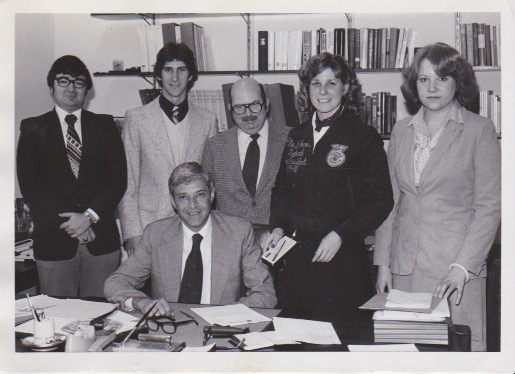
Left-Right; Ed Yoder, Russell Redding, Jim Diamond,
Ellen Duckworth, MeeCee Baker
Infront; Richard Grubb
Dr. Yoder has integrated his philosophy into the classroom by focusing on the person instead of the FFA jacket. He has borrowed strategies from other teachers that have modeled effective teaching as well. A piece of wisdom he shared was: 

"You have to be yourself in an ever changing environment. That means some of your values and beliefs are going to be challenged as educational reforms and changes are constantly proposed. In my personal view, I believe with all the educational reform efforts and proposed changes, the core components of school based Agricultural Education programs provide the foundation for making all education relevant and truly reform education." 

He suggests a few ideas of how to deal with change based on the book Who Moved My Cheese, 

  • Change Happens--They Keep Moving the Cheese
  • Anticipate Change--Be Ready For the Cheese To Move
  • Monitor Change--Smell the Cheese Often So You Know When It Is Getting Old
  • Adapt To Change Quickly--The Quicker You Let Go Of Old Cheese, the Sooner You Can Enjoy New Cheese
  • Change--Move with the Cheese
  • Enjoy Change!--Savor the Adventure and Enjoy The Taste Of New Cheese!
  • Be Ready To Change Quickly And Enjoy It Again--They Keep Moving the Cheese.


Dr. Yoder's career choice was inspired by his high school agriculture teacher Mr. Ken Smith.  Mr. Smith convinced Dr. Yoder to not limit his career options because of his Amish heritage and limited resources. Mr. Smith was a guide, role model, coach, mentor, counselor, and friend to Dr. Yoder. Mr. Smith was being an agriculture teacher, and doing what they do best. He credits agricultural education, through significant role models for motivating him to become a teacher of teachers. His passion for agriculture started when he was young as his family was always involved within the agriculture sector. He realized through an experience organizing a field trip to a dairy farm for a urban school group that far too many people really do not understand the importance of agriculture in their lives. After the field trip the students refused to drink the milk in the cafeteria because it came from dirty cows. 

In his opinion the most important aspect about agricultural education is its uniqueness, and it should be a model for all education. When he was a principal he often would refer back to the basic aspects of agriculture education to resolve issues. Dr. Yoder would visit student's homes, on farms, and businesses as an agriculture teacher and as principal because it helped him understand what the student was experiencing outside of school. Agriculture education made an impact on his life as a teacher of the program using the resources available. The students had impacted his understanding and appreciation for the influence of cultural and economic factors in daily life decisions. He has learned that students reinforce how interdependent we are and how much further we have to go. Learning is a life long endeavor. His favorite part of being an agricultural educator is the people and the relationships and opportunities to work with others that have a commitment to education and agriculture collectively working to enhance the lives of others. Learning to do, Doing to learn, Earning to live, Living to serve.

Over the past 39 years Dr. Yoder has made a lot of great memories with the people (students, faculty, staff, parents, etc.) and activities/events. He doesn't view leaving as taking anything away besides maybe two paper clips, but rather he sees it as making a positive contribution to making Penn State a better education institution. He hopes that he contributed to students having  positive experience as they completed their education at Penn State. We are KNOW you have Dr. Yoder. Thank you for your 39 years of wisdom and inspiration! 

To learn more about starting on the path to having a career that makes a positive impact on the lives of students across the globe by becoming an agricultural educator, please contact the agricultural teacher education program at teachag@psu.edu. Follow us on Twitter at TeachAgPSU, on Facebook, or on our blog.


Luke Kerstetter 

Student Blogger 

Twitter Handle: @lmkerstetter96

2020 Agricultural Education Student Teacher


Tuesday, April 11, 2017

Dr. John Ewing receives College of Agricultural Science "Advisor of the Year" Award: @jce122 @agsciences

Dr. Ewing receiving his award from Chris Toevs,
President, Ag Student Council.
Each year the College of Agricultural Science gives out awards to the different organizations represented within the College of Agriculture. This year the recipient of the "Advisor of the Year" was our very own, Dr. John Ewing. He is the advisor of the Collegiate FFA Chapter at Penn State, and has been for the past seven years. Dr. Ewing has shown his passion for the FFA and all his students through his dedication and commitment to the organization as he goes above and beyond what he is required to do according to the university.


A Short Story from the CFFA
Dr. Ewing makes a point to be present at all CFFA meetings and events that we hold. Many times, this means staying late into the evening and coming in on the weekend. One event that really stands out is when we were preparing for our annual Valentine’s Day rose sale. We had over 500 roses come in that needed to be cut, de-prickled, and prepped for sale the next day. There were four students that began working on the roses after class, but they were still working come 9:00 that night. Dr. Ewing was away on a student teacher visit at the time, and did not get back to campus until 7:00PM. Once he got back, he had another meeting that he had to attend. Dr. Ewing had left home at 6:00 that morning, hadn’t seen his wife or three children all day, and yet still came to help finish the roses. He stayed until we were finished, refusing to leave until the last student left. This level of commitment and dedication to the organization is seen every day in all of the activities and events that we do as an organization.


Dr. Ewing's Attitude and Selflessness
Dr. Ewing poses with students from Collegiate FFA at the 2017 Ag Ball.
He is always present at the club's activities as well as engaging, enthusiastic, and passionate toward them and the goals of the organization. His positive attitude and enthusiasm for agriculture is contagious and inspiring as he is always encouraging students to actively participate in community service, professional development, and student outreach events. Dr. Ewing is looked up to by the CFFA members and is constantly asked for his advice regarding academic decisions and life choices. No matter the time, location, or what is going on at the moment, he takes the time to speak honestly to each student and work out the best option. He does not care if you are not one of his academic advisee students or not, he will go out of his way to help each and every student asking for help. Dr Ewing's selflessness toward the students shows how great of an advisor he truly is to them.

Congratulations Dr. John Ewing on being named the "Advisor of the Year" by the College of Agricultural Science! You have definitely earned it!


 To learn more about starting on the path to having a career that makes a positive impact on the lives of students across the globe by becoming an agricultural educator, please contact the agricultural teacher education program at teachag@psu.edu. Follow us on Twitter at TeachAgPSU, on Facebook, or on our blog.


Luke Kerstetter

Student Blogger

Twitter Handle: @lmkerstetter96

2020 Agricultural Education Student Teacher