Recently during the 2013 National FFA Convention, sixteen students
from across the nation chose to develop themselves professionally with the help of Dupont and NAAE. These sixteen students from
fourteen universities applied and were accepted into the National Agriscience
Preservice Teacher Program, created especially for students that were currently
student teaching or would be teaching in the upcoming spring or fall.
Two students from Penn State were selected, Jessie Ross (@JessieLeeRoss) and
myself (@JRose_Case). To be selected into the program, we had to answer a variety of short answer
questions, submit a resume, and have a letter of recommendation. We were
honored to have been selected for the opportunity.
The preservice program was funded through Dupont Office of
Education and facilitated by the National Association of Agricultural Educators coordinated through Alissa Smith.
The teachers leaders of the program taught the program by example, going through
the different areas and subjects in which inquiry based learning could occur. We
learned how to keep and grade a notebook as we recorded different lab
activities such as, how to write hypotheses, find out if double stuffed oreos
are really double stuffed, photosynthesis and respiration, grizzly greenhouse
murders, and cattle calls.
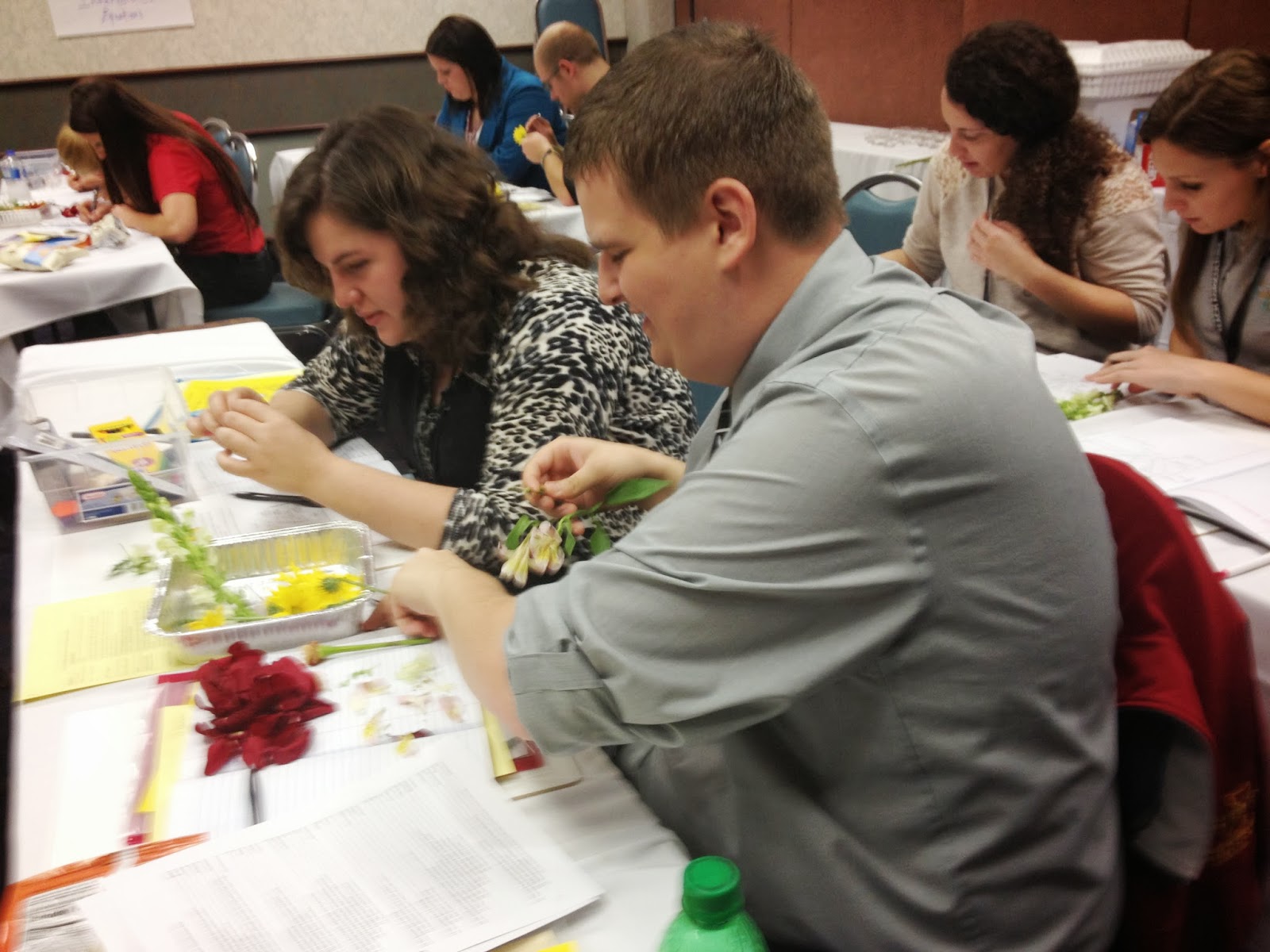 |
| Jessie Ross trying to identify flowers to find the "killer". |
Inquiry based instruction is having students do mental work
rather than the teacher unloading information in front of the students, and it
also helps them to think critically. It is not a passive form of teaching and
reengages students into learning. Instructional strategies that we learned included having the students write reflections in their notebooks in a different color; for example, they can write definitions in a different color.
There were also partner highlighting where two students read the same article and
had different color high lighters. When they are done reading and highlighting, they discussed what they highlighted and their partner will highlighted what the
other person highlighted on their own paper. This got them engaged in a
discussion of what they thought was important and why. It also makes them not
miss anything important because they will have two people on one paper.
 |
| Jeanne Case on left, working together to discover the photosynthesis cycle |
They also gave us classroom management tips. My personal
favorite was stamps to grade a notebook. As students complete different parts of
their project, they have to get approval from the teacher in the form of a
stamp. After they have gotten the stamp, they may move on and continue with the
classwork. This definitely beats dragging home 20 notebooks from one class, and
it also checks understanding throughout the lesson to make sure the students
really know what is going on. Question cards were another avenue since it
limits student questions. They can only as ask many questions as they have
cards.. and yes, may I go to the bathroom does count. This makes them think
more rather than just asking for it to be spoon fed to them when they need
help. Lastly, a way to get students into group is to hand out famous pair
cards. Students will match up with their partner, an example being Louis Lane and
Superman.
Jessie reflected on the experience and said, "I 'm really glad that I had this opportunity to take part in the Preservice Program on inquiry based instruction, learning how to teach students both material and more importantly how to think on there own. Along with the instruction, the instructors also shared great classroom management tips to still keep the room under control without limiting your students, as well as grading tips so that the lessons still have value to the students....I would have never thought that students would work so hard to get their paper stamped until I saw fifteen college students and myself's in action. It truly was a great experience and would really encourage next years student teachers to fill out the application and take part."
Besides from learning a lot about inquiry based instruction,
we also got to meet and work with our peers from across the country. A girl
that I talked to was already student teaching in South Dakota and had a job
lined up for January, which I thought was really impressive for a fast turnover
rate.
It was great to learn more about another form of
instruction, especially before student teaching where mistakes are allowed to
happen and you can really figure out what works and doesn't work for you. Also, classroom management is necessary to learn, because it is necessary everywhere. Lastly, it is important to participate in professional
development events, because as people always say…. It is important to not
invent the wheel twice!
To learn more about starting on the path to having a career that makes a positive impact on the lives of students across the globe by becoming an agricultural educator, please contact the agricultural teacher education program at teachag@psu.edu. Follow us on Twitter at
TeachAgPSU, on
Facebook, or on our
blog!
2014 Dover HS Student Teacher
 Jonathan is originally from Kutztown, PA, past volunteer firefighter, and a former graduate of Agriculture and Extension Education at Penn State. Jon was led to this position because of his natural passion for agriculture education and felt his skill set suited this position well. His past experiences from his childhood, working on dairy farms, training to be a firefighter, and FFA leadership and opportunities are what define his character in present times. Jon's goals in this position is to introduce nanotechnology, 3-D printing, and the use of certification programs in Pennsylvania agricultural education programs, to be a resource for pre-service and in-service educators, and to implement the use project and inquiry based learning through agricultural educators. Outside of work Jon enjoys spending time with his family and dog Axle, as well as watching Penn State Football.
 Beth is originally from Montoursville, PA and a former graduate of Agriculture and Extension Education at Penn State. Beth was led to this position as she was looking to come back to Pennsylvania from the Baltimore area where she taught agricultural education. She felt that this position was the right fit for her, and wanted a change of life. Her past experiences from her supportive parents encouraging her along and teaching in various schools including urban education has defined who she is a person in present times. Her goals in this position are to do the best she can to support programs and teachers (new and beginning) to increase the teacher retention rate. Outside of Penn State Beth enjoys reading, yoga, and chasing her three year old.


