Showing posts with label International Agriculture Minor. Show all posts

Tuesday, April 8, 2014

#psuaged16, Janae Herr in Honduras!

Janae Herr, 2016 Student Teacher candidate
on her trip to Honduras!
“The world is a book, and those who do not travel only read one page.” Over spring break this year, Ag Ed major, Janae Herr, added a few more pages to her book. Janae, a 2016 student teacher candidate, had the privilege of visiting Zamorano University in the Yeguare Valley in Honduras. This trip was part of an embedded course (CED499B) here at Penn State. The course is a Community, Environment and Development class that studies Agricultural communities and development in the surrounding areas.  There were seven students in the group and two faculty members that attended.

While in Honduras, Janae (@kjherr17) had the opportunity to visit several different, small communities in the valley around Zamorano. She said “You could consider Zamorano the equivalent of a Land Grant University here in the states. They operate by a “learning by doing” model, Agriculture Education in its simplest, most effective terms.”

Milking cows with the Zemorano students!
While in some of the communities, the group learned about the efforts going on to increase the tourism industry in order to increase the communities’ income. She also hiked through a biological reserve and visited two elementary schools.

 While the trip was full of awesome opportunities, the ones that stood out to Janae were the ones that related to her passion; agriculture. One of the interesting agriculturally related activities was participating in a number of farm tours. Janae stated

Janae’s greatest takeaway from her trip was the experience she had milking cows with some of the Zamorano students. “Hands down, my most favorite memory of the trip is most assuredly waking up at 3:30 in the morning to join the third year students to milk the cows on campus. Being raised on a Dairy farm, I really enjoyed comparing my farm operation to the University operation while working alongside students.”


Janae showing off her Teach Ag! pride in Honduras!
Traveling to Honduras was Janae’s first time out of the country but she ensures it will not be the last. She recommends taking any chance you get to travel, especially Ag Ed Majors. “As a future Agricultural Educator, I will have the responsibility of preparing my students who are the future of fields like Environmental Resources and Agriculture Research. What better way for me to teach them but with my first hand experiences!”  Along with the Agriculture and Extension Education major, Janae has an International Ag minor. 

To learn more about starting on the path to having a career that makes a positive impact on the lives of students across the globe by becoming an agricultural educator, please contact the agricultural teacher education program at teachag@psu.edu. Follow us on Twitter at TeachAgPSU, on Facebook, or on our blog!


Laura Metrick 
2015 Student Teacher
Twitter: @Its_LauraBeth
Teach Ag! Avenger

Wednesday, August 28, 2013

EARTH to ALLI. Alli to EARTH.

So what did I do this summer? Well there were many small things involved, but the big picture event was a semester of study abroad at EARTH University in Costa Rica. I just got home on Saturday from 4 months of being out of the country and am still processing all of the outstanding opportunities I was blessed with!

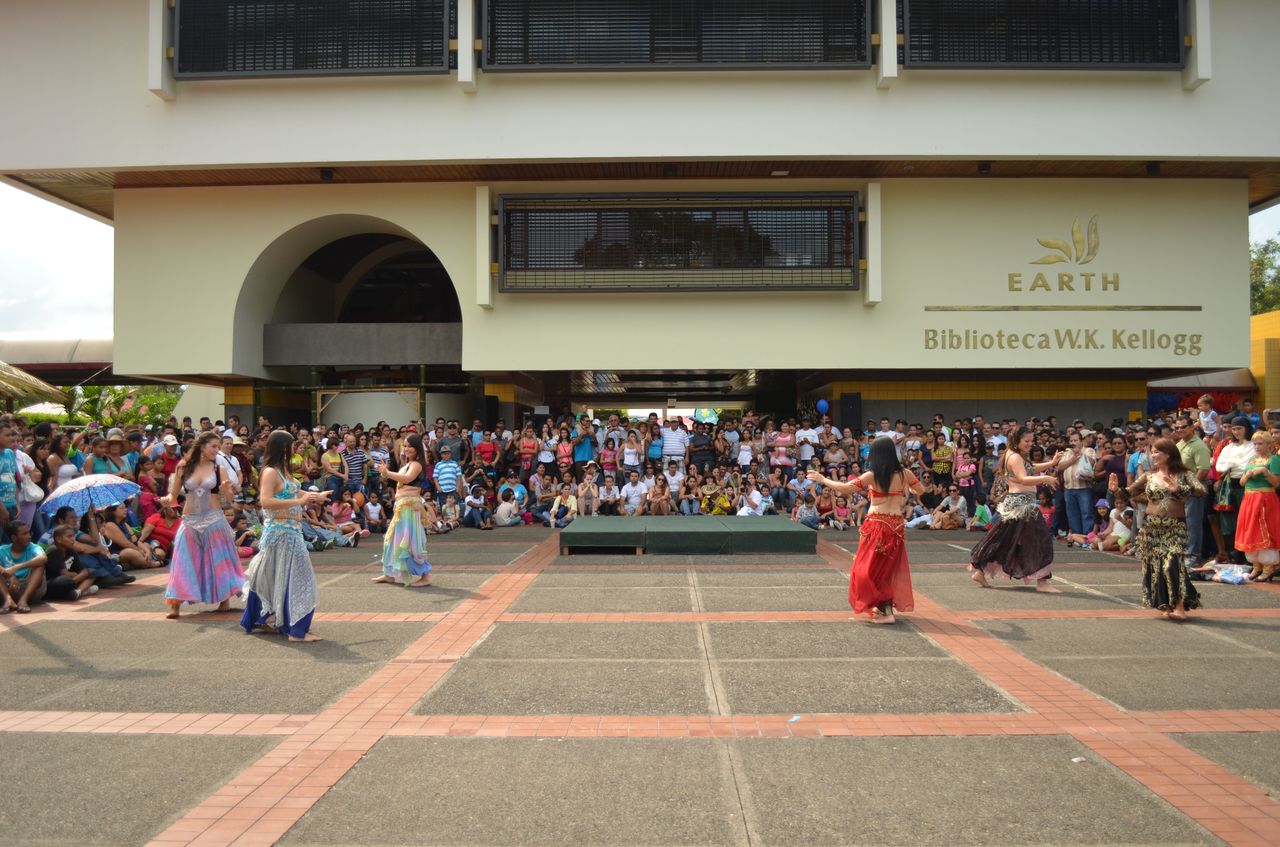
EARTH's cultural diversity was one of my favorite things.
This is from the Multicultural Fair that was held at the beginning of the summer... dances from all over, and amazing food!
The first time to ever use a machete... to cut down a whole plot of plantain plants!
EARTH University is an international private agricultural university, whereas the acronym EARTH stands for (translated from Spanish): agricultural education in the region of the humid tropics. This beautiful university, located on the Atlantic side of Costa Rica, is home to 400 students (over 4 years) who come from over 30 countries in Africa, Latin America and the Caribbean.  I was studying alongside students for one of their three trimesters and just got a snapshot of what it was like to be a student at this incredible institution. Students take every kind of agriculture class imaginable and also must complete a full-year business project, semester-long international internship, and graduation research project (similar to a thesis). They also have 2 days of work experience each week, in addition to their 4 days of classes with lab and field experience. It is definitely a “learning by doing” institution!!

Not a common PSU sight - sheep grazing on the lawn by the soccer field! 
So what did I do there? Well, firstly, I took the following courses to be used for PSU credit: tropical animal production, food security and world economy, community development work experience, mechanical skills (aka shop class), ecological basis for natural resource management, and an oral communication class. Within the first week of class, we were each assigned to maintain a 36 square meter plot of forages in my animal production class, got started on a semester-long project for my natural resources class, and were doing community diagnostics to prepare for working with rural, low income farmers (in my work experience).


Me and my 36 m2 forage plot for an animal production class!

Talking with our agricultural family after lunch one day in the community!

While I was able to gain a lot of new practical experiences (i.e. using a machete for the first time), I would say that the most beneficial component of my international experience was definitely the PEOPLE! God was faithful in providing a beautiful community for me at EARTH and I now have friends from all over the world – from Nigeria to Costa Rica, Mexico to Brazil, and several countries in between. I personally love cultural diversity, so I would often get excited when I realized that a group of X number of friends hanging out would represent X number of countries. Realizing the language diversity of EARTH is also so interesting to me! But let’s not forget to mention that my Spanish speaking skills greatly improved (even causing slight English speaking deterioration at times), as all of my classes were in Spanish!
My EARTH family - friends representing 8 different countries!!
So academic, cultural, and language development were up there on the beneficial experience list. But let’s not forget the travel opportunities! I had a few free weekends to travel around the gorgeous country of Costa Rica during my study abroad, only after a full week of vacations along the pacific coast with my parents (before the semester started). Traveling in Costa Rica included: carpooling, buses, taxis, rental cars, and walking... walking only because it was the means of crossing the Panama border when I needed to renew my passport visa! I was able to see gorgeous beaches in Guanacaste, go white water rafting with my natural resources class (best field trip ever), and spend a few weekends with my Turrialba families (from an immersion experience in Costa Rica last summer).

Favorite travel pic - gorgeous sunset in the Pacific

Thiago (Brazil) and Timothy (Nigeria) took me to some cool national parks!
While this experience was probably the best of my life, I won’t deny there weren’t some struggles. About half way through the summer, I was getting a bit homesick, but I think that was mainly exacerbated by the plethora of tropical bugs (like cockroaches in my dorm room – not a fan), humidity (some mold on my clothes) and class work stress. Spanish speaking language barriers were not too big of a problem for me, thanks to the previous Spanish speaking experience I had when living in Costa Rica last summer (and many years of high school Spanish). But in the end, the benefits and blessings of my time there were what will always remain – and without struggles, how will we grow?

So how can I conclude this incredible, life-changing experience? Well I don’t think I can ever conclude the friendships made, but I will leave you with some interesting numbers to ponder:
  • 17 weeks away from home
  • 29 hours a week of classes and work experience
  • 36 square meters of forages to plant and maintain
  • 14 cockroaches killed in my dorm room
  • 10 hand blisters
  • 1 parrot bite, 1 unknown rash, 1 bamboo splinter rash, 1 case of cold/bronchitis
  • 3 weekend trips to my Turrialba home
  • 2 weekend trips to the other side of the country (Guanacaste)
  • 1 semi-complicated trip to the Panama border
  • 2 overnight camping trips
  • Over 900 photos on my phone
  • Over 3,700 photos on my camera...
  • 10 visits to our rural agricultural community (El Triunfo)
  • Countless mosquito bites
  • Numerous unforgettable friendships
  • A lifetime of memories
If you want to learn more about my incredible experience and maybe see a bit more of EARTH university and its people, check out my blog from the summer!

To learn more about starting on the path to having a career that makes a positive impact on the lives of students across the globe by becoming an agricultural educator, please contact the agricultural teacher education program at teachag@psu.edu. Follow us on Twitter at TeachAgPSU, on Facebook, or on our blog!


Allison Hoover
Guest Student Blogger
2014 Wellsboro HS Student Teacher
Twitter: @allihoov

Friday, August 2, 2013

Helping Others to Help Ourselves: A Summer of #agedu Impact in Nyeri, Kenya

[Editor's Note: Jenna Moser is a Penn State Agricultural and Extension Education Major and a 2015 Teacher Candidate who recently spent the summer in Nyeri, Kenya with the Children Youth Empowerment Centre. This is her story]

The ability to change one’s life is not something to be taken lightly.  It is something that we all have and each and every one of us should conduct ourselves with dignity and compassion.

Jenna on her journey to Mount Kenya
(directly behind her)
.
I am entering my junior year of college majoring in Agriculture Education with a minor in International Agriculture.  My goal is to complete my degree in 2015 and then become involved with a global oriented company and help to teach sustainable agriculture practices to rural farmers (the people who I believe to have the ultimate power in ridding our world’s hunger crisis).  After many years abroad, I hope to return to the United States and serve as a high school agriculture educator.  I want to instill the notion in my students that there is a need for them in this world, and they can make a difference - especially in the agriculture sector.  As a result of my ambitions it made perfect sense for me to enroll in the class that enabled me to study abroad in Kenya.

 Showing a rabbit how to use
the newly replicated rabbit watere
r
On May 9th I boarded a plane in Philadelphia and flew well over fifteen hours to arrive in Kenya to participate in a three week Community Environment Development class offered by Penn State University.  My foresight told me that three weeks would not be enough time, so I was granted permission to stay three months until August 6th.  During the past few months, I stayed at the Children Youth Empowerment Centre (CYEC) in Nyeri.  Essentially, it is a place for children whose parents are either not in the picture or have insufficient funds to provide for basic needs.  These children are brought to the centre with the little if any belongings they have and for the most part have their needs met.  For instance they have food, they all have a toothbrush, they have at least one school uniform, they have space to play with their toy balls cleverly made of grocery bags rolled into one another, they have a strip of foam for their mattress where they can peacefully lay down their heads every night.  These children have literally the most basic things they need, and they are the happiest people I have ever met.

Having fun at a field day at the centre. 
The group that I led named themselves “Team Power”

While I enjoy playing games with the youth and telling them what my sweet mother tells me every night “I love you.  Have sweet happy dreams.  Have a good day at school tomorrow.  I will see you kesho (tomorrow in Swahili).”  I acknowledge that I came to the CYEC to help work with the agriculture component of the centre.  The centre is called “Empowerment Centre” because like a career and technical school in the states, it has several technical components that the youth are encouraged to engage in.  These components are working in a metal shop, wood shop, tailoring room, doing arts such as painting and making jewelry, making charcoal briquettes, and doing agriculture work with the livestock (goats, one cow and one calf, rabbits, and chickens) and working in the shamba (garden) where they grow sukuma wiki (kale), maize, carrots, tomatoes, onions, and much much more. 
Learning how to use a scythe to cut grass for hay; One of the youth enterprises offered at the CYEC and several youth have traveled to many places to make hay and teach others how to. 

As soon as I was exposed to the programs at the centre, I tried to think of how I could be the most beneficial to the agriculture program.  While I did want to be engaged with the “hands on” work of rolling up my sleeves and tilling the soil with a hoe and carrying buckets of water to the animals, I had to constantly remind myself of what is the most sustainable thing for the centre.  I had the realization several times that me doing the work now, could easily translate into no one doing the work when I leave.  So my approach became to work with people one on one and over the course of several days or several weeks teach them different practices, watch them do the work, and then offer my advice.  With this tactic, I was able to successfully implement composting (where there are collection buckets in several parts of the centre), have youth work with the adult in the metal shop to replicate rabbit waterers to ensure the availability of water at all times to the rabbits, I explained the importance of castrating the Holstein calf (especially since the livestock pens are not always shut and there are small children always running around) and performed the operation explaining each part along the way, occasionally I would worked with a jembe (machete) to cut grass for fodder for the livestock, and the most important thing that I did was Teach Ag. 

Cleaning out the space for composting with youth from the CYEC
Working with the head person in the agriculture department we discussed that it would be really beneficial if there was an “Ag Day” at the centre. Simply because the youth see that there are animals and crops, but they do not know how to properly treat them and there is a misconception in developing countries that agriculture is only farming and that it is a “poor man’s job.” That conception is only true for the uneducated and my goal is to change it. I facilitated the first workshop with the older youth where I began asking them to all write down their definition of agriculture. For the most part their responses seemed to be all carbon copied as they dictated the definition ingrained in them during school of “Agriculture is the growing of crops and rearing of livestock.” While this is certainly a component of agriculture, it does not sum up the vastness of this industry.


After that we played games and did puzzles that visually showed: 1) The definition of agriculture, 2) The careers and opportunities offered through the industry, 3) Why they should care about agriculture (I related this to the hunger crisis and shared how critical it is for them to be aware), and 4) Agriculture at the CYEC.
  
Composting buckets and signs were ready to be implemented


At the conclusion of the workshop, I asked everyone to answer the following questions: 1) Did your view change on agriculture? And 2) Are you interested in agriculture? Why or Why Not? Nearly every student said that they were interested in agriculture and one 14 year old girl said “I’m interested in agriculture. Yes because agriculture help the farmer to raise living standards by providing enough food for me family and nation.” Another response from an 11 year old boy was “I am happy because your advice have made me to love agriculture. I love your lesson.” Reading through the responses of the over forty youth was rewarding in the fact that they were able to start the process of comprehending why agriculture is so essential. Following the lesson, I was able to choose a few older youth and worked with them over the course of a week to guide them in creating and presenting their own lesson to the younger youth. They came up with their own materials and explanations about why agriculture is important and their lesson was a success. There is something very gratifying about teaching agriculture and there is something even more fulfilling about teaching others to teach ag.

The ripple effect is monumental. 

Jenna after reaching the top of Mount Kenya (4985 meters above sea level)
after several days of hiking
. 
My short three months in Kenya has flown by and I am leaving with painfully realistic questions of “Did I do enough?”  “Who will tell the precious children sweet dreams?”  “Will I ever see the youth again who have called me their “dada” (sister)?”  “Why is there even a need for a children’s home – shouldn’t parents or family want and be prepared to take care of their children?” 

It is my hopes that these children never lose their sense of compassion and will one day realize that they changed my life.

To learn more about starting on the path to having a career that makes a positive impact on the lives of students across the globe by becoming an agricultural educator, please contact the agricultural teacher education program at teachag@psu.edu. Follow us on Twitter at TeachAgPSU, on Facebook, or on our blog!


Jenna Moser
Guest Student Blogger
2015 Teacher Candidate
Twitter: @JennaLeeMoser