Showing posts with label Professional Development. Show all posts

Monday, April 8, 2019

Tips for Public Engagement!

As we immerse ourselves in the warmer weather and blooming flowers, many of us are gearing up for the various recruitment events, involvement fairs, and conventions that take place throughout the spring and summer. Public events can be successful, engaging arenas to promote your program, or - at the very least - get it into the public's eye. If you've ever attended an event for the purpose of recruiting or showcasing your agricultural, 4-H, or FFA program, you should make sure that you're getting the most out of your time and effort! Here's a little bit of wisdom that I've collected throughout the years and used in my own life:

1. Be Energetic.

We've all seen the table at the county fair with the representatives sitting down in the chairs behind the table... not talking... waiting for the public to come to them. Heck, I know I've been guilty of doing this at one point or another. A big mistake on my part. What I've figured out over the years is that chairs are not for sitting. You want to be out in front of your table, interacting with people, being energetic! Make a reason for people to come up and talk to you - unless if someone is specifically seeking out your program, very few people will be willing to walk up and talk to you if you're hidden away behind your table and disengaged from the event you're at. That chair is for your backpack or your box of recruiting materials, not for you to sit in!


2. Be Relevant to Your Audience.

Part of getting someone invested in what you have to say is being relevant to them. Think of the first time you talk to someone approaching your booth as an interview. That person is essentially interviewing you to figure out if you will be a good fit for them. Here's where that 30-second elevator pitch, that we've all been told to have prepared, comes in handy. Introduce yourself, then have that short pitch for your audience that showcases what your organization is about and why they should care! At the same time ask people questions, learn about them, figure out where their interest lie, and be energetic.  From there, you'll probably be able to identify something that you or the organization that you're representing does that aligns with those interests. If you're willing to engage with the people that are there, they're going to be more willing to engage with you.


3. Be Creative.

Nobody is captivated by a boring table with pamphlets and posters laying on it. If you have the ability to be interactive, plan some sort of activity, idea, or engagement piece that will bring people to your table. Interactive activities are fantastic, especially if you can develop one that showcases something about your organization. For example, if you're representing the local 4-H, plan an activity that involves environmental science, plant and animal science, or STEM. Maybe you can showcase an electrical engineering project a 4-H student created, or have people engage in a gardening activity with something they can take home with them. If you're exhibiting your agricultural program, show off some of the great work your students have done in the greenhouse or in the wood shop. People are much more likely to remember an activity they engaged in or a cool project they saw than a pamphlet.


4. Be Prepared With Contact Information

Make sure to have business cards, flyers, or some sort of way for people to reach you or your program. If someone is interested in the event you're planning or the program you're representing, they need to have a way to find out more information! I've been to a lot of job fairs and recruitment events where very few booths were giving out business cards, let alone any way to reach out to them. What if that student walks away and forgets your meeting time? What if they go home and forget how they can find you or your program? Granted, people know how to Google, but there's nothing quite like handing someone a business card and making that one-on-one connection in-person (and let's be honest, does your program come up on the first page of Google when you search it?).


5. Be Ready for Questions.

Odds are, there's at least a few questions that you frequently get about your organization. Be prepared to answer these questions beforehand. A good strategy I like to use is to sit down and think about all the questions that someone might ask me at an open house or recruiting event, and write out my answers to them. This is a good exercise in being prepared for the inevitable, "isn't FFA all about farming", or "4-H is the arts and crafts club, right?" that might come about from people who don't know much about your organization. Going back to #2, you can even tie in what your organization is about in your elevator pitch so people get the right impression from the start. Basically, you want to have a concise, professional response to any question that might be thrown at you.


That's it - just five short tips that have helped me immensely throughout the past few years of representing and recruiting. This advice can be extended way beyond just representing and recruiting; think about these tips any time and anywhere you represent your program!


Hunter Kauffman
Team Leader, @TeachAgPSU Communications
Wildlife and Fisheries Science
College of Agricultural Sciences

Tuesday, July 10, 2018

The 2018 CASE Institute: What a blast!

The participants of the 2018 CASE Institute.
The 2018 CASE Institute has come to an end, and our participants from all over the country have come out more confident, prepared, and certified to deliver proper instruction on mechanics and technology to their students.

This year's CASE Institute was held at Cumberland Valley High School and hosted by #psuaged alum Ms. Darla Romberger (@DJR_131). The institute ran from June 17th to the 28th, where participants were able to be certified through CASE's Agricultural Power and Technology curriculum.

Over the course of two weeks the program covered 180 days of curriculum, and included topics useful to any agricultural teacher such as shop safety, machine and tool operation, fabrication, energy and power, and more! Attendees got to not only practice themselves, but learn how to meaningfully teach on these topics.

CASE provides 10 courses that fall under four major pathways covering almost every aspect of Agricultural Education. Each of these courses aligns with national standards for agriculture, science, mathematics, and English language arts. The Agricultural Power and Technology course is just one of the many courses that Penn State will continue to help provide for pre-service and in-service teachers.

Follow us on Twitter (@TeachAgPSU) and Facebook to stay up to date on all of the professional development opportunities that Penn State Teach Ag offers, and be one of the first to hear about the 2019 CASE Institute!


To learn more about starting on the path to having a career that makes a positive impact on the lives of students across the globe by becoming an agricultural educator, please contact the agricultural teacher education program at teachag@psu.edu. Follow us on Twitter at TeachAgPSU, on Facebook, or on our blog.


Hunter Kauffman, Student Blogger 
Wildlife and Fisheries Science
College of Agricultural Sciences
Email: hlk5120@psu.edu

Thursday, August 28, 2014

PSU CASE Institute: The Host School Perspective from Cumberland Valley! #case14asp

As the summer was winding down, the Center for Professional Personnel Development and the Cumberland Valley Agriculture Department were putting the finishing touches on the plans to host a Curriculum for Agricultural Science Education (CASE) Summer Institute. The institute hosted this year was Agricultural Science--Plant to complement the previous institutes offered in 2012 (Agricultural Science-Animal) and 2013 (Introduction to AFNR), respectively. With 17 Agriscience teachers from 7 states registered and 2 fantastic lead teachers in place, #case14asp hit the ground running on August 3rd and continued until August 13th.

CASE is a one-of-a-kind curriculum that shifts the classroom towards student-based learning and inquiry-based instruction where students apply critical thinking skills and problem-solving each and every day in the classroom.  Students are challenged to take control of their learning and become an active member of the learning community.  For many agriculture programs, this curriculum is implemented to increase the rigor and relevance of agricultural science while preparing students for diverse careers in the field of technical agriculture.

A unique professional development experience in itself, CASE institutes equip teachers with the content they will teach by employing 2 Lead Teachers that guide participants through key Activities, Projects, and Problems that make up the curriculum. Certified CASE teachers have seen the curriculum through a student's eyes and have completed the lab activities and projects firsthand to lead their classes with confidence through the new content. Rather than leaving with a binder full of worksheets, answer keys and video clips, teachers are prepared to develop an engaging classroom environment and lead students in inquiry-based lessons.

New this year to the CASE arsenal is CASE Online, a resource available to certified CASE teachers. This system provides students and teachers an online method to communicate while completing coursework and share course assignments and assessments. End-of-course assessments and review question banks are now available through this platform for teachers already implementing CASE curriculum.

In addition to learning the curriculum and about available resources, CASE workshops are an excellent opportunity for new and beginning teachers to gain "tricks of the trade" from experienced lead teachers and colleagues with years of teaching under their belt. During several lab activities, participants would volunteer their expertise and provide value-added classroom extension projects that were successful in their past classes. This professional collaboration is often a driving factor in motivating teachers to return to CASE institutes each summer to increase the rigor and relevance of their classes and prepare students for employment in the 21st century food and fiber industry.

Although the end of the institute came way too quickly, the friendships, partnerships, and camaraderie developed at this institute will continue to grow as the 17 certified CASE teachers will communicate throughout the school year and work together through classroom challenges. I look forward to see how my fellow participants will implement CASE in their classrooms this upcoming year and how many students will be impacted through the CASE program into the future.

For more information on available CASE curriculum, CASE Online, and upcoming CASE pilot courses, please visit www.case4learning.org.

To learn more about starting on the path to having a career that makes a positive impact on the lives of students across the globe by becoming an agricultural educator, please contact the agricultural teacher education program at teachag@psu.edu. Follow us on Twitter at TeachAgPSU, on Facebook, or on our blog
Darla Romberger
Cumberland Valley Agriculture Science Teacher
Guest Blogger
Current PSU M.S. Student
2014 PSU Student Teacher


Monday, December 9, 2013

Dupont National Agriscience Preservice Teacher Program from NAAE

Recently during the 2013 National FFA Convention, sixteen students from across the nation chose to develop themselves professionally with the help of Dupont and NAAE. These sixteen students from fourteen universities applied and were accepted into the National Agriscience Preservice Teacher Program, created especially for students that were currently student teaching or would be teaching in the upcoming spring or fall.

Two students from Penn State were selected, Jessie Ross (@JessieLeeRoss) and myself (@JRose_Case). To be selected into the program, we had to answer a variety of short answer questions, submit a resume, and have a letter of recommendation. We were honored to have been selected for the opportunity.

The preservice program was funded through Dupont Office of Education and facilitated by the National Association of Agricultural Educators coordinated through Alissa Smith. 

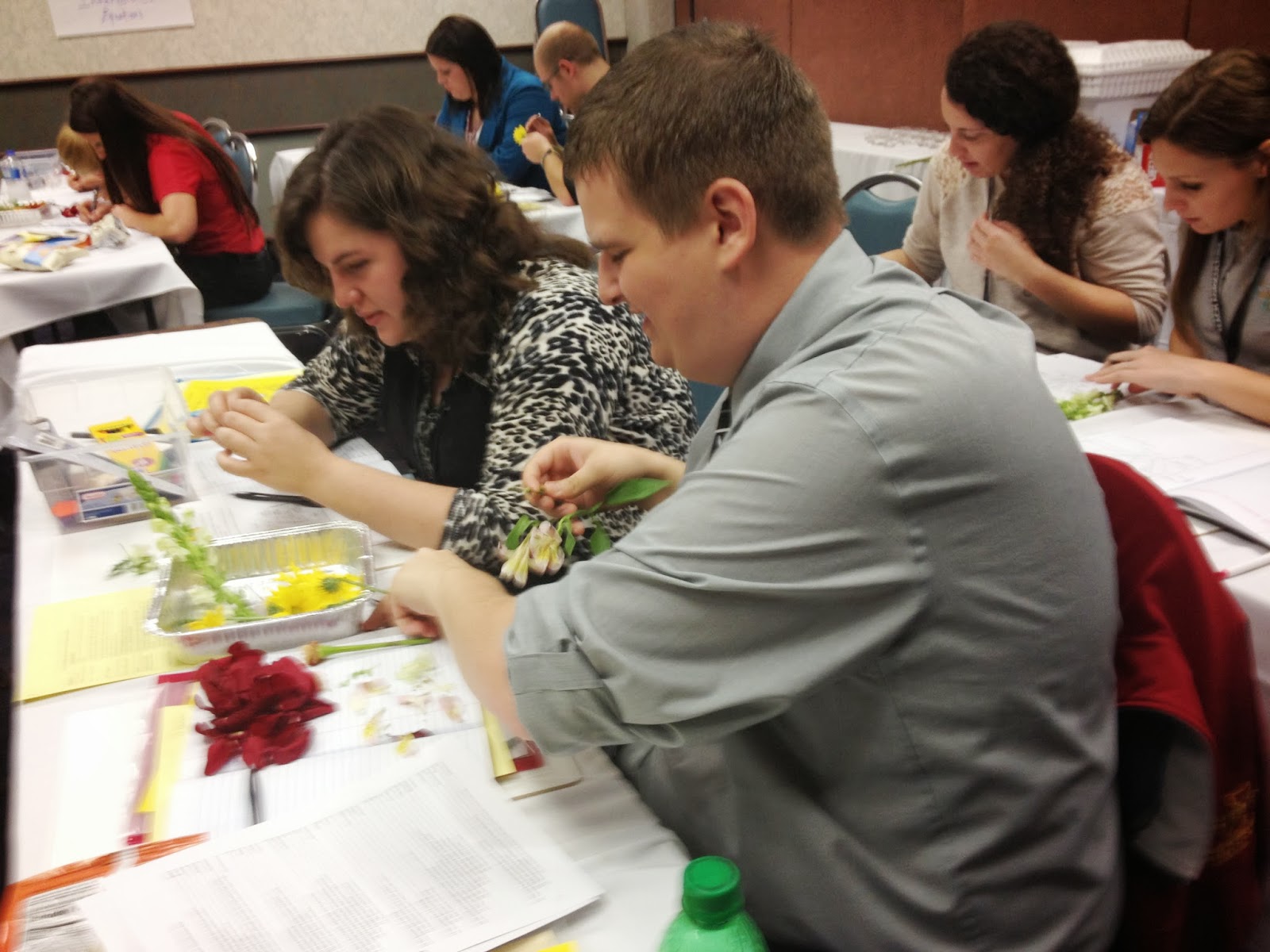
The teachers leaders of the program taught the program by example, going through the different areas and subjects in which inquiry based learning could occur. We learned how to keep and grade a notebook as we recorded different lab activities such as, how to write hypotheses, find out if double stuffed oreos are really double stuffed, photosynthesis and respiration, grizzly greenhouse murders, and cattle calls.

Jessie Ross trying to identify flowers to find the "killer".
Inquiry based instruction is having students do mental work rather than the teacher unloading information in front of the students, and it also helps them to think critically. It is not a passive form of teaching and reengages students into learning. Instructional strategies that we learned included having the students write reflections in their notebooks in a different color; for example, they can write definitions in a different color. There were also partner highlighting where two students read the same article and had different color high lighters. When they are done reading and highlighting, they discussed what they highlighted and their partner will highlighted what the other person highlighted on their own paper. This got them engaged in a discussion of what they thought was important and why. It also makes them not miss anything important because they will have two people on one paper.


Jeanne Case on left, working together to discover the photosynthesis cycle
They also gave us classroom management tips. My personal favorite was stamps to grade a notebook. As students complete different parts of their project, they have to get approval from the teacher in the form of a stamp. After they have gotten the stamp, they may move on and continue with the classwork. This definitely beats dragging home 20 notebooks from one class, and it also checks understanding throughout the lesson to make sure the students really know what is going on. Question cards were another avenue since it limits student questions. They can only as ask many questions as they have cards.. and yes, may I go to the bathroom does count. This makes them think more rather than just asking for it to be spoon fed to them when they need help. Lastly, a way to get students into group is to hand out famous pair cards. Students will match up with their partner, an example being Louis Lane and Superman.

Jessie reflected on the experience and said, "I 'm really glad that I had this opportunity to take part in the Preservice Program on inquiry based instruction, learning how to teach students both material and more importantly how to think on there own. Along with the instruction, the instructors also shared great classroom management tips to still keep the room under control without limiting your students, as well as grading tips so that the lessons still have value to the students....I would have never thought that students would work so hard to get their paper stamped until I saw fifteen college students and myself's in action. It truly was a great experience and would really encourage next years student teachers to fill out the application and take part."  

Besides from learning a lot about inquiry based instruction, we also got to meet and work with our peers from across the country. A girl that I talked to was already student teaching in South Dakota and had a job lined up for January, which I thought was really impressive for a fast turnover rate.

It was great to learn more about another form of instruction, especially before student teaching where mistakes are allowed to happen and you can really figure out what works and doesn't work for you. Also, classroom management is necessary to learn, because it is necessary everywhere. Lastly, it is important to participate in professional development events, because as people always say…. It is important to not invent the wheel twice!

To learn more about starting on the path to having a career that makes a positive impact on the lives of students across the globe by becoming an agricultural educator, please contact the agricultural teacher education program at teachag@psu.edu. Follow us on Twitter at TeachAgPSU, on Facebook, or on our blog!


Jeanne Case
Student Blogger
2014 Dover HS Student Teacher
Twitter: @JRose_Case

Monday, July 22, 2013

PAAE Summer Conference - Student Teacher Style

[Editor's Note: Every year, we conduct an orientation for cooperating teachers, university supervisors, and teacher candidates to ensure that everyone is on the same page for the upcoming year/internship. We purposefully conduct this at the summer conference of the agricultural teachers association to introduce students to the professional organization. Below is the perspective of one 2014 teacher candidate, Ms. Jeanne Case, who will be student teacher at Dover High School. Follow the adventures of this student teaching group on Twitter at #psuaged14]

A couple weeks ago I attended the Pennsylvania Association of Agricultural Educators (PAAE) conference in Manheim, PA. Since I am interning with the PA Farm Bureau this summer and am living in Harrisburg I was a simple 45 minutes away from the conference – or so I thought. As per typical Jeanne, I got lost and was late despite giving myself an extra 15 minutes when I left home. Thankfully one of my peers, in my student teaching cohort, Mr. Billy Saylor, called me and gave me directions and I did not miss that much of the conference.

My peers and I started the conference meeting with our student teacher mentors and talked about what the perfect student teaching experience would look like. Ideas were thrown around, such as our individual experiences with different aspects of FFA – ACES, SLLC, chapter meetings, CDE’s, etc. We also thought it would be good to go to department meetings, meet with the principal and other teachers in the building, as well as attend a school board meeting. Respect of the students, teachers, and each other was also an important subject. Some people seem to think that the student teachers have to be in competition with each other since we are graduating at the same time and looking for jobs. This year we are striving to work together, to really help each other out, to work as a family and a team. We should be building each other up rather than breaking the group down.  Drama is not an option in our cohort.

After we met with the teachers and Dr. Foster and Dr. Ewing, we split off for some focused instruction for teacher candidates with leaders of the program and recent graduates like Ms. Laura Rice, Ms. Mackenzie McCollum and Mr. Doug Masser. They tried to calm our fears of the upcoming semesters. They also stressed how it is important to dress tastefully because we may have the opportunity to meet important people and it is important to present yourself well because everything is an interview. We went over appropriate clothing for different events.  Dr. Foster is not the best at expressing what girls should be wearing –" uh, nice pants and a shirt" - is not a detailed enough answer for a girl.  Ms. Rice and Mackenzie were really helpful. The individuals running this session also stressed that if we keep up with our work, rather than waiting until the end of the semester, that student teaching really is manageable and will not “kill us”.

Student teacher, Billy Saylor, with the winery grapes
We also received our own teacher " big idea"  books to keep track of any ideas that we may want to use later or things that we will want to look up to implement in the classroom.
Following lunch we split into different groups and went to a session that was hosted by teachers from across the state. I went to an electrical lesson where three different teachers shared how they teach electrical wiring in their class. All of them did it completely different but it still got the same point across.Students learn things differently and it was nice to see different ways to teach the same subject. It will be important to keep that in mind during our teaching career as some techniques may work with some students and not with others – it is good to keep an open mind and be willing to change your teaching style to help a student learn.  Insanity is defined as doing the same thing over and over and expecting different results.

As PAAE is an agricultural conference we. of course, have to support ALL aspects of the agricultural industry so we went on an industry tour of a local winery. We toured the farm then got to learn how they process the grapes on the farm and make their product. We even got to sample that product with a little swirl, smell and sip. To bring out the different flavors there were local cheeses and crackers provided as different foods change the taste palate of your mouth and create a different experience.

Student teachers listening to a presentation about the wine industry in PA
To end the evening we had dinner at a local auction barn and played Minute to Win it. Teams were made up of teachers and student teachers alike as we battled to win. It was a good bonding experience for all involved, the participants and spectators alike. Lots of the games were quite silly and it got everyone out of their shells, mingling and forming connections, which is what conferences and networking events are all about. Here are a few example videos of competition in action!!

Dr. John Ewing in the infamous "Pencil Snatch". Mad Skills

Mr. Herb Hoffeditz puts his nose in it!

Our Teacher Educators Team Up. Dr. John Ewing & Dr. Daniel Foster

2014 Student Teachers Billy Saylor and Caleb Wright Exhibit Team Work!

The second day of the conference and the last day for the student teachers had us attending more workshops to learn of opportunities that we can provide to our future students such as certifications, dual enrollment and tests to prove that our students are learning adequately, to name a few.

We were also able to listen to issues happening in the state, such as state days and other events. There was time to network with different teachers from across the state and make connections and friendships. I even met a woman whom I had talked to previously via email and facebook that is an alumni of the Greek organization I am involved with. It turns out that she was in the house the same time as my mom and that she and my mom actually worked together in the pasture research lab sorting different types of weeds. My mom even went to her wedding and took wedding photos for her. I love to network and make connections and I also love to meet alumni as they just seem to pop up out of nowhere and provide excellent resources. I also met another man who is actually the father of my student teacher mentor; I had talked to him on the phone last fall to interview him for a project in one of my AEE classes. It was very nice to be able to put faces to names.

We, the student teachers, ended our portion of the conference with a meeting to discuss why it was important that we were there and the importance of professional organizations. Agriculture is such a small industry while being so large.  It is important to help each other out and share ideas, as it helps the industry to constantly grow in the forward direction.  On behalf of this spring’s student teachers I know that we were very appreciative of the opportunity to attend the conference, to make friends and to learn a lot about the profession that we are about to enter. It was a great jump start to the fall semester!

To learn more about starting on the path to having a career that makes a positive impact on the lives of students across the globe by becoming an agricultural educator, please contact the agricultural teacher education program at teachag@psu.edu. Follow us on Twitter at TeachAgPSU, on Facebook, or on our blog


Jeanne Case
Student Blogger
2014 Dover HS Student Teacher
Twitter: JRose_Case